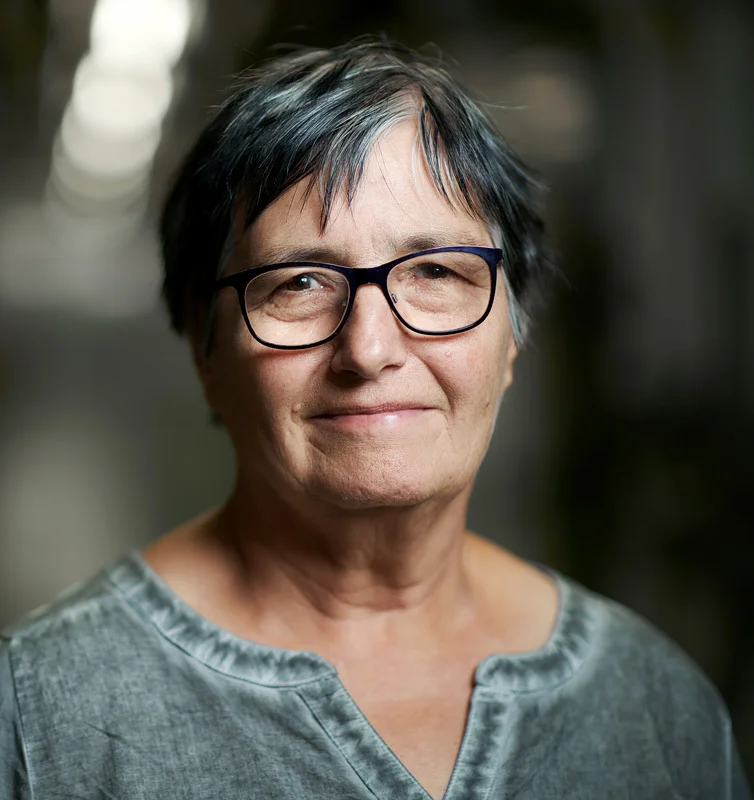
When the ESA’s Rosetta spacecraft reached Comet 67P/Churyumov–Gerasimenko in 2014, it carried a Bern-based instrument: the ROSINA mass spectrometer, led by Prof. Kathrin Altwegg. It provided the most detailed chemical fingerprint of a comet to date and evidence that the building blocks of life are more widespread in space than previously thought. Altwegg is Professor Emerita of Space Research at the University of Bern; she headed the Centre for Space and Habitability from 2011 to 2016 and has been a member of the SATW since 2021. In July 2026, she was a guest on the SRF summer series ‘25 Years of Tagesgespräch’, where she provided an insight into her research. She is convinced that manned spaceflight is not conducive to research and that the likelihood of life in space is high. As part of the SATW’s ‘Space’ theme month, she answers questions and explains her views.
You recently said that manned spaceflight is not conducive to research because human traces, for example, would distort results. So, from a scientific point of view, is the current boom in manned lunar and Martian programmes more of a step backwards?
With every unmanned space probe, we transport material from Earth into space, to the Moon or Mars. This includes bacteria and viruses. That is unavoidable. From the International Space Station (ISS), we know that certain bacteria can survive the conditions in space for many years. However, the problem becomes far more serious with manned spaceflight. Humankind has already left more than 200 tonnes of rubbish on the Moon, including the Apollo astronauts’ faecal bags, which are teeming with bacteria. As a result, the Moon is no longer truly untouched. Furthermore, manned spaceflight is extremely expensive – many times more so than robotic missions. All over the world, we are trying to carry out processes using robots. Yet, of all places, we want to send humans into the hostile environment of space. From a scientific point of view, this makes no sense.
They also warn that, from 2032 onwards, a person could die every other year as a result of falling space debris. How serious is this danger really? And in your view, who bears responsibility when private companies continue to launch new satellites into space unchecked?
This figure comes from the US Federal Aviation Administration (FAA) in a 2023 report to the US Congress. This report is probably long out of date; for example, the mass of a Starlink satellite is estimated at 286 kilograms, whilst the satellites recently launched on Starship weighed 1,700 kilograms. The likelihood of me, as an individual, being struck by a piece of space debris is much smaller than that of being struck by lightning. But space debris is man-made and could be avoided. I imagine there will be a huge outcry when the first person loses their life in this way. According to the UN Outer Space Treaty, responsibility lies with the state and the authority that authorised it – in Starlink’s case, the US FAA. However, unchecked activity in space has far more negative consequences.
Such as what, for example?
All communications satellites operate in orbits that are very similar in terms of altitude. This directly leads to overcrowding and increases the risk of collisions. SpaceX had to carry out more than 355,000 evasive manoeuvres within a year, and the trend is rising. Sooner or later, collisions will occur, causing the amount of space debris to grow exponentially. This poses the risk that satellites will soon no longer be able to exist in these orbits. Furthermore, it is becoming increasingly dangerous for space probes – particularly manned ones – to traverse this region on their way to the Moon. Another unresolved problem is the burning up of space debris in our atmosphere. It remains unclear what effects debris particles have in the upper atmosphere. Aluminium oxide, an ozone-depleting substance, plays a significant role here. Ultimately, the plans of Elon Musk and other companies could spell the end of ground-based astronomy. Will we only see satellites instead of stars and planets in the future?
Using the ROSINA data from the Rosetta mission, you have found evidence of molecules relevant to life on comets and say that the chances of life in space are high. Where does this confidence come from? What do we still need to actually prove such a discovery?
Comets are the most primordial celestial bodies in our solar system. They formed far from the Sun and are extremely cold. The hypothesis was that such primitive bodies contain only small, simple molecules, and that more complex molecules only form on planets. However, we have detected a large quantity of complex organic molecules. The molecules on the comet formed abiotically, that is, without the involvement of life. Most of these molecules are older than the Solar System and are therefore ‘universal’. Some of these molecules can also be detected in interstellar space using radio telescopes and the James Webb Space Telescope. So what happened on Earth may well also have happened on one of the countless other planets in the universe. However, to this day we still lack molecules that can unequivocally confirm the presence of life. This is a challenge we must address before we can claim that there is life on exoplanet XY.
Some of the ROSINA data is still being analysed. What unanswered questions or potential new insights might this dataset still hold? What exactly are you and your team currently working on?
We are currently analysing nitrogen-containing organic molecules and attempting to reconstruct their evolutionary history. These molecules are relevant to prebiotic processes. So far, we have only analysed a small portion of the mission data, as this is predominantly manual work. We therefore plan to analyse a larger proportion of the two million mass spectra using AI. This should help us to compare comet data with data from asteroid missions, the rings of Saturn and the moons of Jupiter, thereby gaining a better understanding of the processes in the early Solar System. The research remains fascinating.
Rosetta was an ESA mission involving many countries and spanning decades of planning, construction and operation. What does it mean in practical terms to lead a key scientific instrument on such a major international mission? What role should Switzerland play in future European missions of this kind?
With such a large and long-running mission, patience is paramount: patience on the part of the researchers, but also on the part of the funders. During the construction of instruments and the flight phase, publications tend to be few and far between. What is needed is a good infrastructure, long-term continuity, no ‘haphazard’ approach, technical staff who remain with the project over the long term, and, of course, a strong international network. Together with Swiss industry, we are in a position to develop measuring instruments at the cutting edge of technology. Switzerland has been very successful in such missions, particularly thanks to the PRODEX programme – and not just with Rosetta. To ensure this continues, the framework conditions must remain flexible and avoid excessive red tape, so that we can really focus on hardware, international cooperation and collaboration with industry.
You say that so far we only understand five per cent of the universe and expect artificial intelligence to yield important new insights, for example into dark matter. How is AI currently changing astrophysics? Where do you also see risks associated with this development?
At the moment, several telescopes are under construction, in operation on Earth or in space, such as Euclid, the Nancy Grace Roman Space Telescope and the Vera C. Rubin Observatory. They are all tasked with investigating the nature of dark matter and dark energy, which we still do not understand. These telescopes generate enormous amounts of data – between 10 and 20 terabytes per night – which cannot be processed without AI. What is striking is that a great many researchers now only know the sky through their computers. It is easier to vary model parameters and thereby produce publications than to grapple with the fundamental principles of physics and with hardware. With AI, this becomes dangerous, as AI cannot ‘think critically’ but simply recognises patterns. Yet perhaps the pattern is a quirk of the telescope rather than of the sky itself. Without independent thinking on the part of researchers, this will lead to unscientific results.
You raise the question of which form of life counts more: that on Earth or that on an alien celestial body, given that we might potentially destroy life there through manned and unmanned missions. How did you personally arrive at this stance?
As Director of the Centre for Space and Habitability at the University of Bern, I was required by the university management to work in an interdisciplinary manner. We took this seriously and sought dialogue with theologians. This made ethics a central issue, and with it the question of which life is more valuable: life on Earth or extraterrestrial life. My answer is clear: life on other planets is of equal value. However, we have also known – at the very latest since the COVID-19 pandemic – how a new virus can very quickly endanger life. So, before we land on other planets, we must ensure that we do not endanger any life there, should it exist. Conversely, when we bring material from other celestial bodies to Earth, we must be certain that we are not endangering life on Earth in the process. That is why, following the Apollo 11 mission, the astronauts had to spend 21 days in quarantine. Subsequent investigations have, however, shown that this quarantine was completely inadequate and would in no way have prevented the contamination of Earth with any lunar viruses.
By detecting the building blocks of life on a comet, you are touching on the question of what ‘life’ actually means at its chemical core. Where, for you personally, does the line between complex chemistry and life lie?
Four ingredients are necessary for the development of life as we know it: liquid water, energy, organic molecules and time. Two of these ingredients are found on comets: organic material and time. But that alone is not enough for life to emerge. There are various definitions of life, but none is complete. It requires metabolism, reproduction, evolution, homeostasis, and so on. The best definition comes from a philosopher: ‘Life is recognised by its effects.’ This is similar to the physical concept of force. We recognise life when we encounter it. Comets are non-living, as they lack liquid water. Whether we will ever be able to create life from non-living matter, I do not know. I hope that this step remains beyond our reach. It is unthinkable what humanity would do with such a capability!
You were one of Switzerland’s first female physicists and, with Rosetta, helped shape one of the greatest successes in European space exploration. What would you like to see the next generation of space researchers do differently from your own?
Space research is a team effort. When I look back at my predecessors, Professors Johannes Geiss and Hans Balsiger, they did a great deal right. They gave us PhD students and postdocs a great deal of responsibility and freedom, were exceptionally good teachers, and supported us wherever they could. They respected technicians, secretaries and mechanics just as much as they did scientists. These qualities are somewhat less common in my generation. I hope that future generations will embody these qualities to a greater extent and understand that it is not just about their own success, but about the success of the whole team. As a woman, I naturally hope that women and men are represented equally within the team, that it is taken for granted that women are active in space research – including in leadership roles – and that they are taken seriously.
Kathrin Altwegg is an astrophysicist and professor emerita of space research at the University of Bern, as well as a former director of the Centre for Space and Habitability. She led the ROSINA mass spectrometer on board ESA’s Rosetta comet probe, thereby providing key insights into the composition of comets and into molecules in space that may be relevant to life. In the 1970s, she was one of the first women to study physics in Switzerland.
In 2021, she was admitted to the SATW as an individual member – in recognition of her pioneering role in comet research and her commitment to promoting young scientists at all levels.
Space exploration is closer than it seems—and Switzerland plays an important role in it. During SATW’s Theme Month “Space: Switzerland as a Space Nation”, you’ll find more stories, developments, and perspectives on research, technology, and space exploration from Switzerland.
| Role | Title + Name |
|---|---|
| Text by | Esther Lombardini |
| Expertise | Kathrin Altwegg |