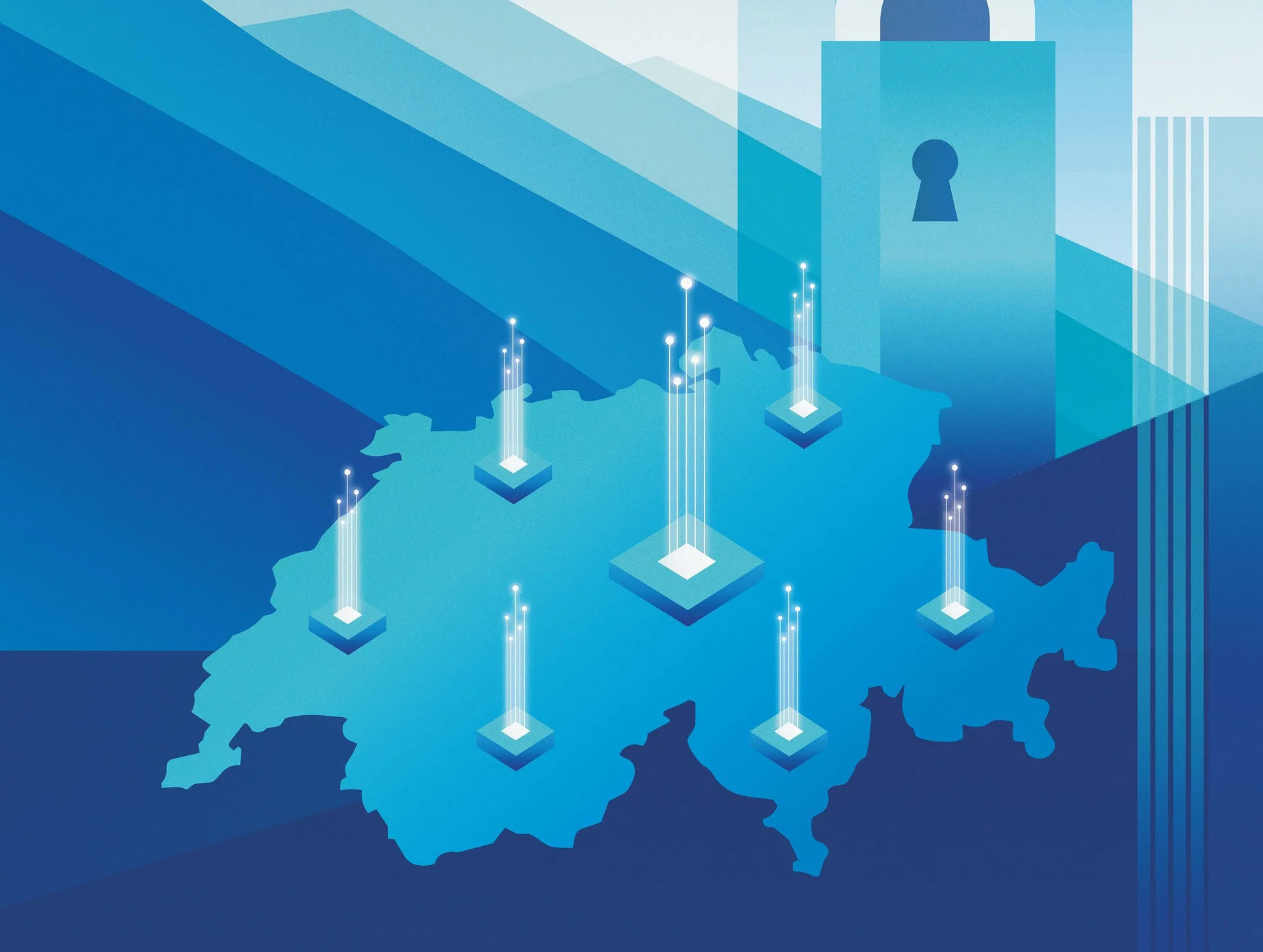
Developments in the field of artificial intelligence are currently dominated by the massive expansion of cloud infrastructure. This is causing a second, equally significant development to take a back seat: AI models are increasingly running directly on end devices – on smartphones, sensors, industrial robots or in vehicles. This so-called edge AI processes data where it is generated, rather than transmitting it to remote data centres.
This has far-reaching consequences, particularly for cyber security. Because sensitive data remains local, edge AI strengthens data protection and digital sovereignty on the one hand. On the other hand, however, the proximity of data, AI models and hardware increases the attack surface and shifts responsibility for cybersecurity from the cloud to the operators of the end devices.
To ensure that Switzerland does not miss out on this development and can deploy edge AI securely and reliably in future, the SATW’s Cybersecurity topical platform outlines specific courses of action:
Rapid developments in the field of AI are increasingly taking place at the local level. To ensure that Switzerland can utilise edge AI in a secure and trustworthy manner, the courses of action discussed here should be implemented.
This factsheet is based on the work of the Cybersecurity Topical Platform of the Swiss Academy of Engineering Sciences (SATW). The Topical Platform identifies relevant developments in the field of cybersecurity and draws up recommendations for policymakers, industry and society.
Find out more about the Cybersecurity Topical Platform
Find out more about cybersecurity at the SATW.
This factsheet examines the implications for cyber security of AI models increasingly being deployed directly on end devices rather than in the cloud. It outlines options for action to ensure that Switzerland can use edge AI securely and reliably.
Edge AI refers to AI systems that operate locally on end devices – such as smartphones, sensors, industrial robots or in vehicles. The data is processed where it is generated, rather than being transmitted to a remote data centre. The boundaries between cloud AI and edge AI are fluid, with various possible combinations, such as AI training in the cloud and AI deployment at the edge.
Edge AI enables fast response times, reduced bandwidth requirements, offline availability, built-in protection of sensitive data (‘Privacy by Design’) and resource-efficient data processing. These advantages stem primarily from the fact that data is processed locally and that edge AI models are significantly smaller than cloud models.
Edge AI offers both advantages and disadvantages in terms of the triad of confidentiality, integrity and availability. On the one hand, local data processing enhances data protection and reduces the risk of data being intercepted. On the other hand, the proximity of data, AI models and hardware increases the local attack surface and the number of attack vectors. Cybersecurity responsibility is thus shifting from the cloud to the edge.
Edge AI enables fast response times, reduced bandwidth requirements, offline availability, built-in protection of sensitive data (‘Privacy by Design’) and resource-efficient data processing. These advantages stem primarily from the fact that data is processed locally and that edge AI models are significantly smaller than cloud models.
The factsheet recommends that the business community proactively implement recognised standards: zero-trust architecture principles (NIST SP 800-207), international standards for industrial automation (IEC 62443) and new security standards for AI models with mandatory red-teaming tests. Where voluntary initiatives are insufficient, regulations should require high-risk systems to adhere to the principle of ‘security by design’. Furthermore, providers must increasingly rely on trusted execution environments (TEs) to protect data and code at the hardware level through physical separation.
It is aimed at decision-makers in politics, business and research who are involved in cybersecurity and the secure use of AI systems.
The factsheet was produced by the Cybersecurity Topical Platform of the Swiss Academy of Engineering Sciences (SATW). The project was led by Tobias Schlegel. Twelve authors from the fields of research, business and public administration contributed to its production.
| Role | Title + Name |
|---|---|
| Project management | Tobias Schlegel |
| Editorial staff | Esther Lombardini |
| Text by | Umberto Annino, Daniel Caduff, Stefan Frei, Roger Halbheer, Pascal Lamia, Martin Leuthold, Hannes Lubich, Raphael Reischuk, Bernhard Tellenbach, Daniel Walther, Andreas Wespi |