Translated by an automated translation plugin.
In three ongoing pilot projects in Switzerland, highly automated, so-called Level 4 vehicles are being used in regular road traffic. These vehicles can drive completely autonomously within restricted areas. However, even in an emergency, the system must be able to bring itself to a safe state without human intervention.
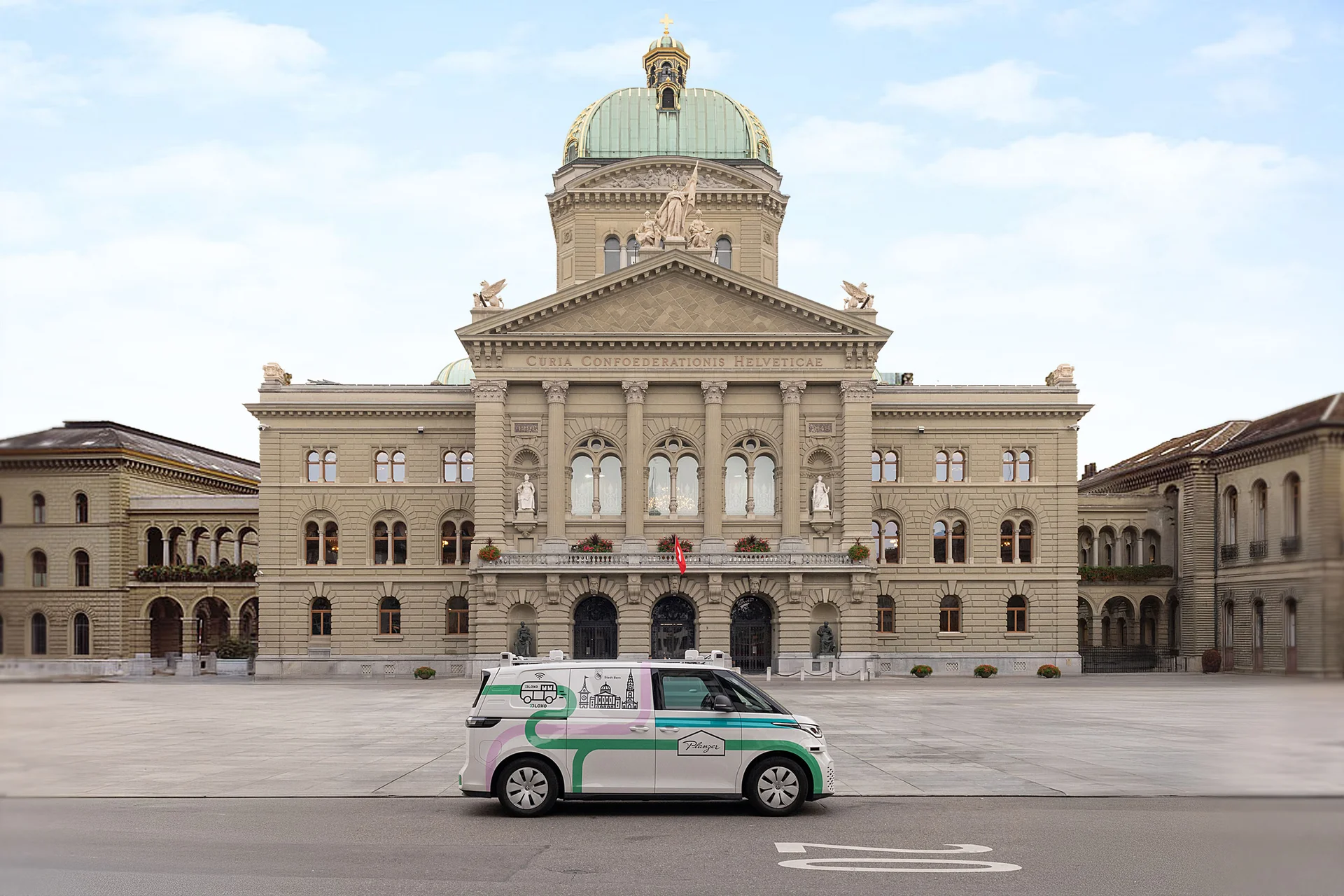
Since 2024, the logistics company Planzer and the technology start-up Loxo have been testing in the city of Bern how a highly automated delivery vehicle can be integrated into the logistics processes for the final-mile delivery of parcels. Automated vehicles are also undergoing trial operations in the Furttal valley in Zurich as part of a larger pilot scheme. They are set to transport passengers without a driver before the end of 2026. Another PostBus project in eastern Switzerland is filling gaps in public transport in rural areas and is set to enter regular service with 25 vehicles from 2027.
These pilot projects are made possible by a pilot licence issued by the Federal Roads Office (ASTRA). The Ordinance on Automated Driving, which came into force in March 2025, establishes the framework for regular operation, which is the aim following these projects. Whether the ongoing development of autonomous driving should be subject to stricter regulation is the subject of heated debate in Swiss politics. The Federal Council is due to set out its position on this issue in a report on a parliamentary postulate later this year.
The pilot projects all follow a step-by-step approach towards highly automated, driverless operation. Planzer and Loxo are the furthest along in their project. In May 2026, they received authorisation from the Federal Roads Office (ASTRA) to operate without a person behind the wheel who could take control at any time. The journeys are monitored remotely from a control centre, but a supervisor in the front passenger seat continues to act as a fallback and could trigger an emergency stop at the touch of a button. This milestone on the path to high automation is unique in Europe to date.
In an interview with the SATW, Björn Lindner, Head of Innovation at Planzer Transport and a member of the Autonomous Mobility thematic platform, discusses the experiences and challenges of the pilot project.
Mr Lindner, the project by Planzer and Loxo reached an important milestone in May 2026. How do you view this success, particularly in comparison with international developments in automated driving?
For us, this is a major step forward, but by no means a foregone conclusion. We have deliberately proceeded step by step: initially with a safety driver behind the wheel, and now with a safety passenger in the front passenger seat as a fallback – always with the principle that safety comes first. In the US or Asia, scaling up is often done more quickly and boldly. The Swiss approach is more cautious, but that is precisely what builds trust – with the authorities, the public and our customers.
How do the challenges of introducing automated vehicles in logistics differ from those in passenger transport, which is the aim of the other pilot projects?
The biggest difference is acceptance. We’re not transporting people – that removes a whole level of reservations. Someone entrusting a parcel to an autonomous vehicle has fewer concerns than someone getting in themselves.
However, we face other challenges: integration into existing logistics processes is complex – we operate in a hybrid world where autonomous vehicles and conventional routes run in parallel. To achieve this, we need suitable loading and unloading areas that the vehicle can access automatically. And the economic focus has been clear from the outset: improving efficiency – not at some point in the future, but from day one. This is what drives us, both from an operational perspective and with regard to sustainability and optimising urban traffic.
Safety and emergency response are key considerations in automated driving. What specific experiences have you gained in this regard during the project?
Phase 2 – without a safety driver behind the wheel – has only been running for a few weeks. During this period, apart from targeted tests, there were no risk-mitigating manoeuvres. Situations in which the automation software encountered uncertainties were resolved by the remote supervisor – without the need for any risk-mitigating manoeuvres. This must remain a last resort: an abrupt stop in city traffic disrupts the flow of traffic, and this must be avoided. The automation rate and performance of the autonomous driving system must deliver the highest quality in an urban environment – we are continuing to work on this continuously together with our partner Loxo.
What has surprised me most is the openness of everyone involved. The staff at our branch in Bern have supported the pilot project from the outset with curiosity and commitment – not with scepticism. New technology as a support, not a threat: that is our aim, and I’m delighted to see that’s how it’s being received. We’ve observed a similar attitude amongst the people of Bern: openness and a constructive engagement with the topic – we hadn’t expected this to such an extent.
Remote monitoring is working well. However, the pilot project involves one-to-one monitoring – one supervisor per vehicle. One of the key challenges we can clearly see today is connectivity. Stable network coverage with high bandwidth is not yet available everywhere – and this is precisely the basic prerequisite for remote monitoring to function safely and effectively. And if, in future, a member of staff monitors several vehicles simultaneously, this will give rise to entirely new requirements – both operational and technical.
As for returning the vehicle to traffic after an emergency manoeuvre: this has not yet been an issue in day-to-day operations, as there is still a safety passenger in the vehicle during the current phase who can take charge of this. However, the insights gained from the work within the thematic platform are already helping us to prepare this process for the next phase and the roll-out.
One of the key questions we are asking ourselves as fleet operators is: should we, as operators, set up our own control centre, or should we procure this as a service? The issue is what capabilities and technical requirements a logistics company needs to operate Level 4 vehicles on a day-to-day basis. We are actively pursuing this question. The answer to this will help determine how we scale up.
From practical implementation to the technical and scientific background: the SATW’s Autonomous Mobility thematic platform is a working group of experts that has been addressing the fundamentals and technologies in this field since 2018. It assesses opportunities and risks in a neutral and fact-based manner, with a particular focus on the safety of automated vehicles.
Against the backdrop of progress in the introduction of vehicles with higher levels of automation, the group devoted itself last year to the question of how these vehicles can handle unexpected situations and emergencies, and what role a potential control centre might play in this.
Current international regulations and standards require that, in such emergencies, a risk-minimising manoeuvre be carried out to bring a highly automated vehicle to a halt. Furthermore, once such a driverless vehicle has come to a safe stop following an emergency manoeuvre, it generally requires external assistance to be guided back into traffic. This is where a control centre – or a so-called external operator – comes into play.
The thematic platform has summarised its assessments of these emergency manoeuvres and the subsequent reintegration into traffic in a discussion paper, which in particular:
Based on these analyses, the discussion paper highlights regulatory gaps that need to be addressed in this area and recommends further research, for example to extend the findings to other use cases of automated driving. It also discusses the extent to which automated driving systems can be improved so that intervention by an external operator can be avoided entirely.
The discussion paper is aimed specifically at experts and specialist bodies in the field of autonomous driving. If you are interested in the document or in the Autonomous Mobility thematic platform, please contact us.
| Role | Title + Name |
|---|---|
| Text by | Christian Holzner |
| Expertise | Björn Lindner |