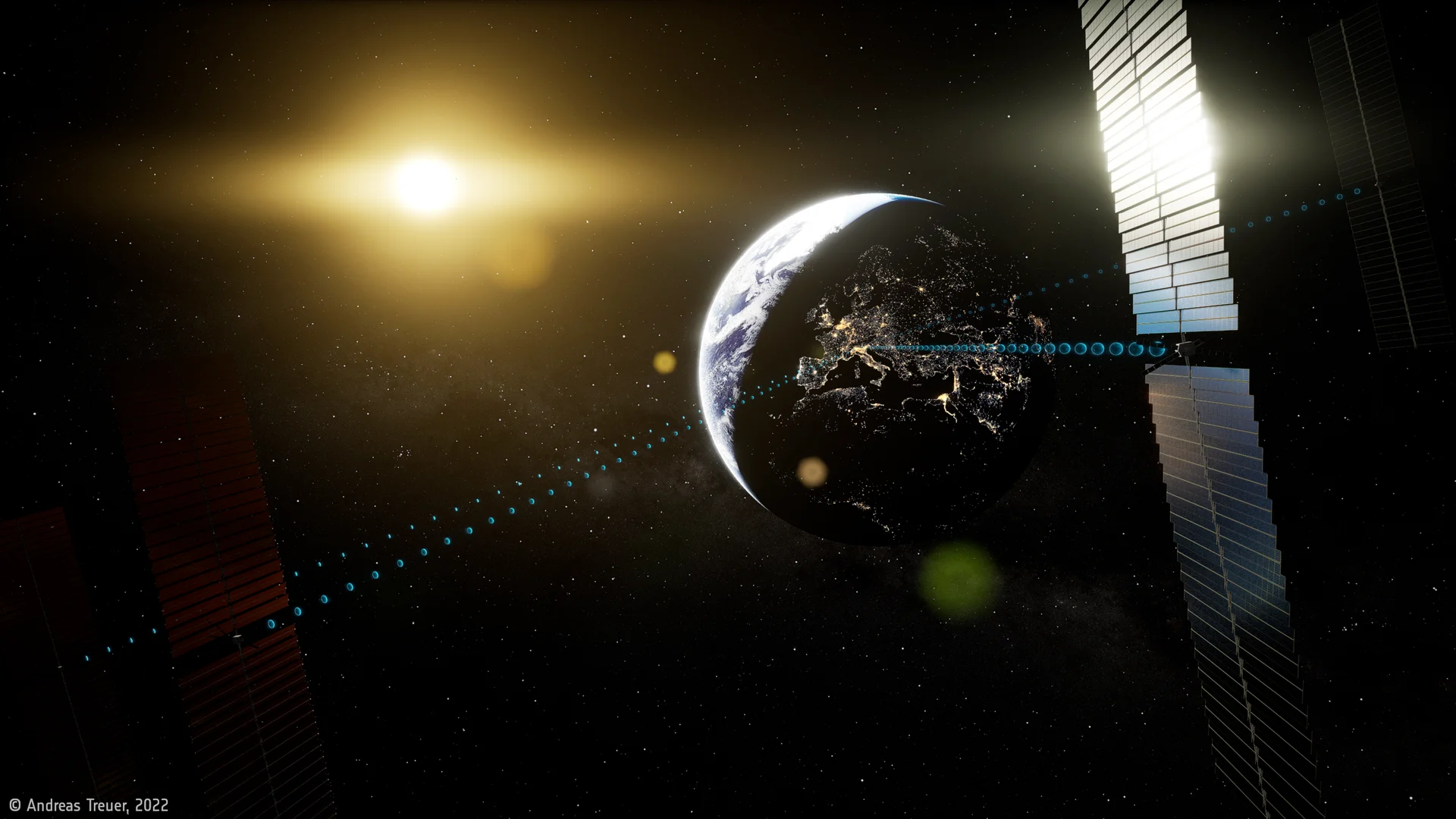
The sun provides the Earth with far more energy than humanity needs. However, its light does not always reach the ground everywhere: at night, photovoltaic systems cease to function entirely; clouds reduce their output; and in countries such as Switzerland, they generate comparatively little electricity in winter. So why not harvest solar energy where neither clouds nor the cycle of day and night interfere – in space?
The idea of such space-based solar power stations, known as ‘Space-Based Solar Power’ (SBSP), is about half a century old. Put simply, huge solar installations in orbit would convert sunlight into electricity. This would then be converted into microwaves, beamed to Earth and converted back into usable electricity by receiving antennas.
‘The main advantage would be almost uninterrupted energy production,’ says Christophe Ballif, a professor at EPFL and founder of the photovoltaics division at the CSEM research centre in Neuchâtel. According to most concepts, such installations would orbit the Earth at an altitude of around 36,000 kilometres. There, they would always remain directly above the same point on the Earth’s surface and be bathed in sunlight almost continuously. Only at certain times would they briefly enter the Earth’s shadow. Furthermore, the intensity of the sun’s rays at such an altitude is 36 per cent higher than on Earth – and there are no clouds.
All the major space agencies now have SBSP on their radar and have developed initial concepts. This is because many of the technologies required for such space-based power stations are already well advanced. Satellites and spacecraft, for example, have been powered by solar panels for decades. At present, multi-junction solar cells made from so-called III-V semiconductors are primarily used for this purpose. Several semiconductor layers stacked on top of one another each utilise different parts of the solar spectrum, thereby achieving efficiencies of more than 30 per cent.
However, such cells would be hardly suitable for large-scale solar power stations, says Ballif. They are about a thousand times more expensive than terrestrial silicon-based solar cells; moreover, the elements required for them, such as gallium and germanium, are not available in unlimited quantities. Consequently, interest is growing in cheaper alternatives – such as silicon cells, which, however, have a lower efficiency and are sensitive to radiation from space. According to Ballif, there are, however, ways to improve the resilience of such cells. ‘For example, by using thinner wafers or by incorporating layers through which hydrogen migrates into the solar cell, where it partially repairs radiation-induced defects.’
Ballif’s team specialises in the development of ultra-thin, ultra-light solar cells with high output. The researchers recently published findings on a perovskite-perovskite-silicon triple-junction cell with an efficiency of 30 per cent. “This opens up the possibility of matching the performance of III-V cells – but at the cost of conventional terrestrial solar cells,” says Ballif. Together with the start-up HelioW Space, the CSEM is investigating the potential of perovskite cells for space applications.
However, a high-performance solar cell on its own does not yet constitute a space-based power station. Especially as such installations are eventually intended to generate power comparable to that of a Swiss nuclear power station. To achieve this, a solar array covering several square kilometres and weighing thousands of tonnes is expected to be required, says Arthur Woods, founder of the Swiss company Astrostrom and a long-standing advocate of space-based solar energy. They would have to be launched in separate parts, assembled in orbit, aligned and maintained over decades. Added to this would be transmitters and power electronics, and on Earth a so-called rectenna would be required: a field of antennas covering up to 30 square kilometres, which would capture the microwaves and convert them into direct current.
Woods sees logistics as the biggest hurdle. “The technologies for SBSPs basically exist,” he says. “The major challenge is getting structures of this size into space and assembling them.” A space-based power station could require dozens or even over a hundred launches of a very large launch vehicle. It remains to be seen whether sufficient launch capacity will ever be available and whether transport costs will become low enough for this effort to pay off.
Nor has there yet been a demonstration of feasibility for transmitting energy back to Earth. Microwaves are considered the preferred solution because they penetrate clouds and the atmosphere relatively well. However, the conversion process involves significant power losses: Woods estimates that, from a plant capturing solar power in the region of seven gigawatts, approximately one gigawatt would reach Earth as electricity.
Nevertheless, he is convinced that space-based solar energy could make an important contribution to energy supply in the long term. With Astrostrom, he is even pursuing a concept that sounds like science fiction: the long-term idea is that parts of the solar power stations should be produced from raw materials sourced from the Moon. Because the Moon has only about one-sixth of Earth’s gravity, it would be less costly to transport components from there into space than from Earth. Although Woods’ business plan envisages implementing such a system by 2045, But he realises that this would require enormous investment and development.
Christophe Ballif also sees major hurdles for these futuristic space-based solar power stations. “Lightweight, durable solar panels, efficient transmission to Earth, and the lifespan and costs of the entire system will pose enormous challenges,” he says. He also warns against relying on such technologies, which are still entirely uncertain: “We must first invest in affordable solar energy, wind power and batteries here on Earth in order to decarbonise our energy system.” This does not rule out further research into approaches such as SBSP – but space-based solar power must under no circumstances replace terrestrial measures.
Nevertheless, interesting opportunities could open up for Switzerland: over the next few years, space agencies as well as start-ups are planning initial demonstrations to generate energy in space and transmit it to Earth in a controlled manner. Swiss universities and technology companies, with their expertise in robotics, high-performance electronics and precision mechanics, could provide key building blocks for such projects.
And who knows, says Arthur Woods, if the feasibility and economic viability of SBSP come within reach, a combination of logistics, funding and political will could suddenly provide the necessary impetus.
Space exploration is closer than it seems—and Switzerland plays an important role in it. During SATW’s Theme Month “Space: Switzerland as a Space Nation”, you’ll find more stories, developments, and perspectives on research, technology, and space exploration from Switzerland.
| Role | Title + Name |
|---|---|
| Text by | Simon Koechlin |
| Expertise | Christophe Ballif, Arthur R. Woods |