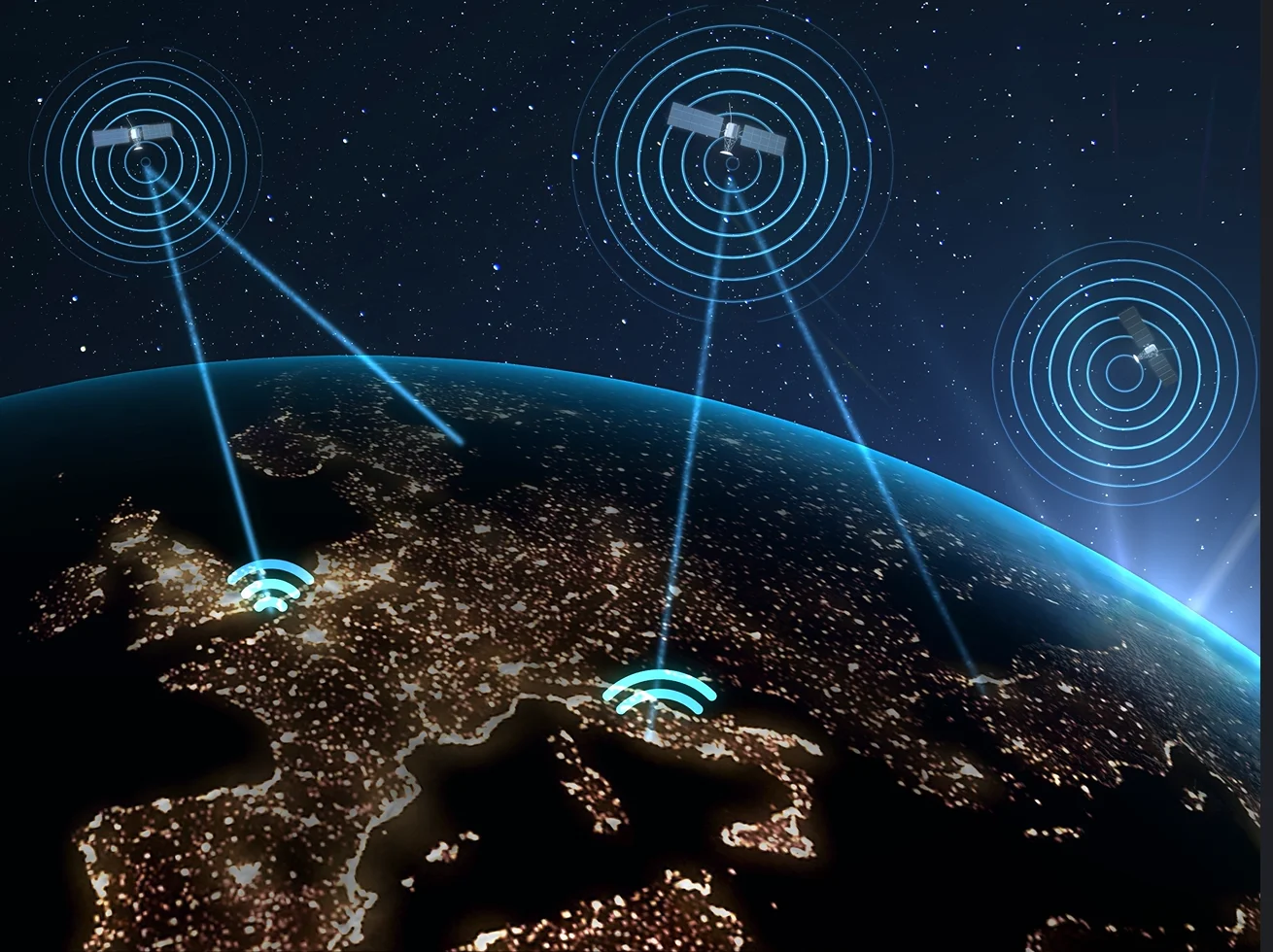
Somewhere in the mountains, out at sea or following a natural disaster, the mobile network suddenly goes down. Until now, this has rendered smartphones largely useless. That could be about to change. Several companies are setting up satellite networks through which standard mobile phones are to connect directly. This technology, known as ‘Direct-to-Cell’ or, more generally, ‘Direct-to-Device’, shifts part of the mobile network into space.
The principle sounds simple: instead of communicating with a mobile phone mast in the vicinity, the smartphone communicates with a satellite in low Earth orbit, known as a LEO satellite. This satellite relays the connection via a ground station to the standard network. Neither a satellite dish nor a special satellite phone is said to be required for this.
Technically, however, the project is anything but straightforward. “A key technology for this is large active phased-array antennas on the LEO satellites,” says Hua Wang, Professor of Electronics at ETH Zurich. Such antenna arrays consist of a vast number of individual elements, whose signals can be electronically bundled and precisely directed. Only in this way is the satellite able to ‘hear’ and reach a standard smartphone on Earth.
Interactive graphic
With Direct-to-Cell, an ordinary smartphone connects straight to a satellite in low Earth orbit. The sheer distance is the central technical challenge.
Select one of the four stations to see what happens there and who controls it.
Four stations, four possible operators in four possible jurisdictions.
The biggest problem with direct-to-cell technology is distance. According to Wang, a typical mobile phone cell on Earth has a range of around one kilometre. However, a LEO satellite usually orbits about 500 kilometres above the Earth; unless it is directly above the user, the radio link can be around 1,000 kilometres long. The signal therefore has to travel a distance 500 to 1,000 times greater. ‘This results in the signal being attenuated by more than 150 decibels – it arrives at the satellite one quadrillion times weaker than when it was transmitted by the mobile phone,’ explains Wang.
Because a mobile phone typically transmits at 200 to 500 milliwatts, after this long journey the power received by the satellite is in the region of less than one femtowatt. “The challenge is to filter out this tiny radio signal from the background noise,” says Wang. Increasing the transmission power of the smartphone is not the solution – after all, the whole point of the technology is that it can be used with an ordinary device. So, says Wang, it is primarily the satellite that needs to become more powerful.
The possibilities are still limited. So far, only low data rates have been able to be transmitted from smartphones to LEO satellites, says Adrian Perrig, Professor of Network Security at ETH Zurich. Furthermore, data rates could be severely affected by weather conditions, such as heavy thunderstorms. Nevertheless, Direct-to-Cell is far more than just a distant pipe dream. The Starlink satellite network, operated by the US space company SpaceX, has already placed more than 650 satellites equipped for mobile communications technology into low Earth orbit. In collaboration with local mobile network operators, SpaceX is already offering such services in countries such as the US and New Zealand.
Such services are currently still limited to applications with low data requirements, such as emergency communications and text messages. However, Hua Wang expects rapid progress. In future, he believes full-fledged voice connections and, to a limited extent, broadband connections will be possible if the phased-array antennas become even larger and more powerful. Preparations are also in full swing on the organisational front: the international mobile communications standardisation body 3GPP has already incorporated non-terrestrial networks into the 5G standard.
In Switzerland, Starlink is collaborating with the mobile network operator Salt. In July 2025, Salt conducted a successful test in Interlaken – the first provider in Europe to do so – in which a text message was sent directly via a Starlink satellite to a conventional 4G smartphone. However, no licences have yet been granted by the relevant authorities for commercial operation.
Will we communicate exclusively via satellites in future? Hua Wang does not believe so. Rather, he says, different systems will co-exist in future: traditional ground-based cellular networks, Direct-to-Cell via LEO satellites, and possibly high-altitude platforms such as drones or balloons. Direct-to-Cell could, on the one hand, bridge coverage gaps in remote and mountainous regions, at sea or in the air, and, on the other hand, step in when mobile networks collapse due to severe weather, natural disasters, power cuts or overload.
However, these new communication channels via space also raise security concerns. ‘Satellite connections are much easier to eavesdrop on, as anyone with an antenna can track the signal,’ says Adrian Perrig. This does not automatically mean that an eavesdropper can also read the content of encrypted communications. But secure encryption and authentication will become particularly important for such networks.
Hua Wang sees further vulnerabilities. “Unlike a ground-based base station, satellites cannot simply be located, inspected and repaired,” he points out. Their already weak radio signals can also be disrupted by jammers. An even more fundamental question is who controls the infrastructure and communication channels. A LEO satellite orbits the Earth at around 7.5 kilometres per second and can cross several national borders within minutes. The smartphone, satellite, ground station and mobile network used to establish a connection may belong to different companies and be located in different countries. This raises questions regarding data protection, data sovereignty, regulation and jurisdiction.
Added to this is the fact that today’s satellite fleets are predominantly operated by large non-European companies. “A dependency on Starlink, for example, could pose a sovereignty issue for data communications,” says Adrian Perrig. Hua Wang also advocates building a space communications infrastructure controlled by Europe – or, better still, one developed and manufactured here.
He also sees this as an opportunity for Switzerland. It would make little sense, he says, to attempt to build our own global satellite constellation here. It would be far more promising to supply the key technologies required for this. Future direct-to-cell satellites require active antenna arrays with thousands of channels, high-performance radio-frequency electronics, integrated circuits, photonics, precision manufacturing and secure communications – all areas in which Swiss universities and companies possess outstanding expertise.
| Role | Title + Name |
|---|---|
| Text by | Simon Koechlin |
| Expertise | Adrian Perrig, Hua Wang |