Translated by an automated translation plugin.
Prof Isabelle Wildhaber opened the conference with the question "Is it too early for AI regulation, is it too late?". The question is justified, as the EU AI Act - a comprehensive set of European Union regulations governing the development and use of artificial intelligence (AI) - came into force on 1 August 2024 and is to be implemented in stages by 2030. However, discussions are also currently underway to simplify this AI Act, along with other EU legislation in the digital sector, in order to reduce the administrative burden on companies. Just the day before, a proposal was adopted as part of the Digital Omnibus, as this project is called, to push back the deadline for the entry into force of the provisions on high-risk AI systems by a few months.
Switzerland is pursuing a different path: it decided against adopting the EU AI Act, but instead wants to ratify the Council of Europe Convention. To this end, a consultation draft and an implementation plan for legally non-binding measures are currently being drawn up. Wildhaber summarised the situation aptly: "We are not in a status quo, everything is very much in flux." The rest of the day was led by your colleagues from the Law & Tech Lab, Prof Miriam Buiten, Prof Monika Simmler and Prof Mariana Valente.
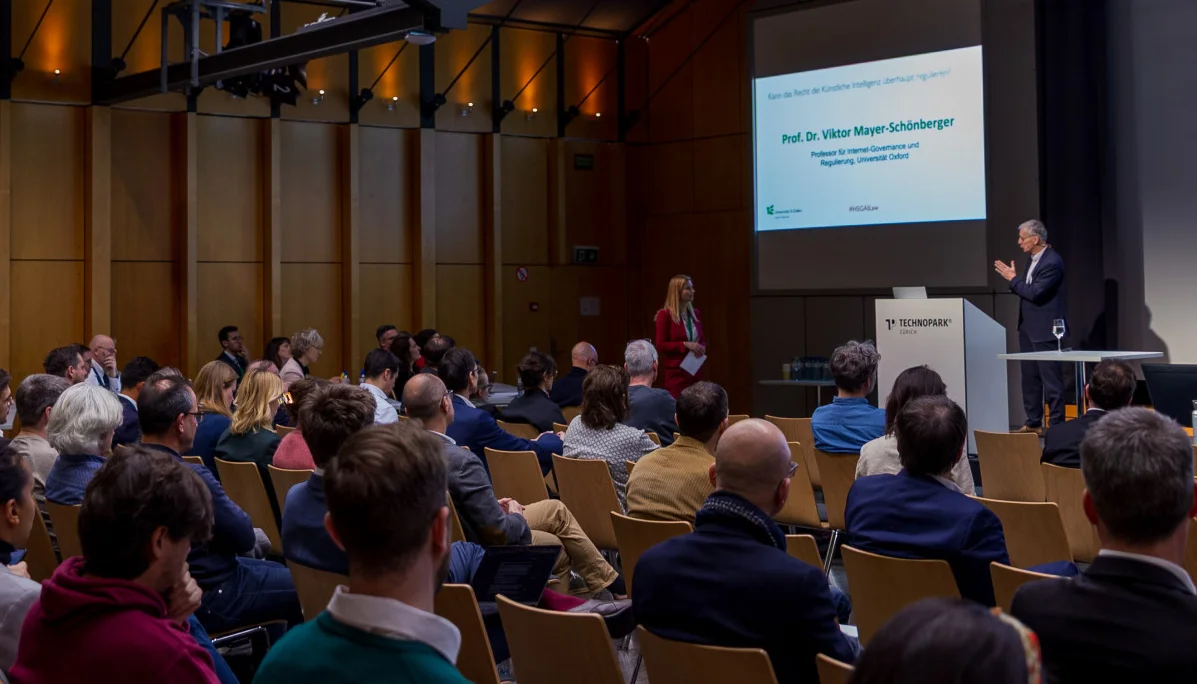
Prof Viktor Mayer-Schönberger from the University of Oxford took a step back and opened the discussion. Mayer-Schönberger seems to like asking uncomfortable questions. First of all, he failed to provide a conclusive answer to the title question. To summarise, however, it is probably: formally yes, in reality it is somewhat more complicated.
The EU AI Act exists, so regulation is possible. But Mayer-Schönberger urged modesty: you can't want everything at the same time - strengthening the internal market, promoting innovation, combating discrimination and safeguarding fundamental democratic rights. That was too much for a single set of rules. What does regulation really aim to achieve if everything is to be covered by it?
The following are the three theses that the author believes should guide AI regulation.
Discrimination by AI often arises from unbalanced training data. As this in turn is based on human error, this does not change the fact that unlawful AI applications must be corrected. Complete freedom from prejudice is illusory - which is why regulation should focus on those biases that cause the greatest harm. According to Mayer-Schönberger, transparency rarely solves complex regulatory requirements.
AI extrapolates from past data into the future. This works as long as tomorrow resembles yesterday. But people think differently: they dream up new options that do not exist in any training data set. The first alpine ascent of Everest in "alpine style" served as an analogy - Habeler and Messner dreamed up a new route instead of taking the familiar one. AI regulation must not undermine this human ability, but should protect and strengthen it.
Regulation must protect human agency, support human learning - and recognise itself as provisional. Laws are also decisions that can be revised. However, this presupposes that legislative processes do not become so cumbersome that mistakes can no longer be corrected.
During the discussion, the question was raised as to why people were always calling for laws instead of talking about principles. Mayer-Schönberger referred to a joint book with Urs Gasser: we need standards at different levels - flexible, changeable, capable of learning.
Sabrina Konrad from the Institute of Intellectual Property (IPI) provided a sober picture of the situation in the Swiss capital. The initial situation: AI systems are using copyright-protected works for training on a massive scale - and nobody knows exactly what this means in legal terms.
There is currently no standardised law in either Switzerland or the EU that clarifies the conditions under which AI may be offered, used or trained. This leads to legal uncertainty for everyone involved: creative professionals, researchers and companies.
The Gössi motion is regarded as the initial parliamentary impetus in Switzerland. It covers a broad spectrum of interests - from creative professionals to advocates of the innovation centre. Various regulatory approaches are under discussion: a barrier solution, collective rights management or self-regulation. The opt-out option for rights holders is particularly controversial. As expected, the stakeholder reactions from a participatory event in October 2025 showed different preferences.
The IPI's current course points in the direction of collective rights management, differentiated according to domestic and foreign AI providers. A draft of the revised Copyright Act (E-URG) should be available by the end of the year.
Rarely does a panel discussion become as productively controversial as the one between Serdar Günal Rütsche from the Zurich Cantonal Police and Dr Rahel Estermann from the Digital Society, moderated by Prof. Monika Simmler.
The police are facing a real operational problem: terabytes of video surveillance footage, recorded in 4K and 360°, can no longer be viewed by humans. AI-supported video analysis - for example, recognising suspicious movements or abandoned luggage - is technically possible and makes work much easier. Günal Rütsche emphasised that there is a legal basis for every deployment and that governance guidelines are in place.
Estermann counters this: For people who feel they are being monitored, it doesn't matter who is spying on them. The decisive difference lies in the type of detection:
The term "chilling effect" was used several times: the basic feeling of being watched restricts freedom, even if no one is actually looking. In Zurich, there is now a legal basis for pilot projects with biometric facial recognition. Data protection impact assessments are monitored externally - a transparency gesture that did not reassure everyone.
Prof Désirée Klingler focused on a little-noticed but extremely practical problem: how does the state actually procure AI systems? The short answer: often not as it should.
The federal government is spending a growing proportion of its purchases on technology. The legal requirements, such as a public invitation to tender from CHF 230,000, are clear and regulated in EMBAG - the Federal Act on the Use of Electronic Means for the Fulfilment of Government Tasks. In practice, however, the situation is different and many projects are awarded by private treaty or divided into small lots, even though they would have to be put out to tender.
The result: vendor lock-in. The "highlander" effect, in which a single provider is considered to have no alternative, becomes entrenched - be it due to technical specialities, intellectual property rights or successor procurements. In practice, a few large providers such as Microsoft and Amazon therefore dominate.
Article 9 of the EMBAG contains an obligation for open source software - "public money, public code". Klingler sees this as a promising approach, but the implementation leaves a lot to be desired. An upstream market clarification is rarely carried out because the necessary expertise is lacking and there is no knowledge of which systems are available and what they can do.
Dr Susanne Kuster and Jonas Zaugg from the Federal Office of Justice (FOJ) gave an honest insight into the workshop of Swiss AI regulation. You are in the middle of it, not at the end. Participation is a top priority, for which the FOJ has utilised a variety of different channels, such as an advisory group and a participatory workshop in October 2025.
Three work streams are running in parallel: preparation of a consultation draft focussing on the public and private sectors where fundamental rights are affected, non-binding measures and ongoing sector-specific activities.
The core topics of the proposal include transparency, impact assessments, supervision, data protection and non-discrimination. Supervision could be taken over by an existing authority, distributed among sector-specific bodies or a new, independent authority could be created.
The current timetable envisages a consultation at the beginning of 2027 with parliamentary deliberation expected in 2028. Until then, the EU AI Act will remain the dominant reference model - albeit with the "Digital Omnibus" package of March 2026, which has postponed high-risk provisions. Switzerland is observing, learning - and is also involved in the Council of Europe Convention, which it intends to ratify.
The panel discussion on digital sovereignty was perhaps the most emotional of the day - and that on a topic that actually feels sober.
According to Dr Nina Gammentahaler from the Federal Chancellery, the Federal Council understands the term digital sovereignty as control and the ability to act in the digital space in order to ensure the state's tasks. Concrete approaches are apparently underway within the framework of EMBAG, a hybrid multicloud strategy and a desire for more coordination within the federal administration. But what is the real state of Switzerland's digital sovereignty?
Prof Matthias Stürmer from Bern University of Applied Sciences made no secret of his assessment: the glass is half empty. Germany has created a centre for digital sovereignty, France has "LaSuite" with various open source tools. Switzerland? Wait and see.
Adrienne Fichter from the Republic also painted a less reassuring picture: attempts by tech giants such as Amazon and Mircosoft to put pressure on federal offices, extended framework agreements that cement a dependency that should actually be reduced. Large providers are not always the most favourable. Switzerland pays billions to these companies in the public sector.
Markus Brönnimann from the canton of Basel-Landschaft formulated the problem of cantonal decision-makers precisely: "With SaaS solutions from large providers, the loss of control is so extensive that legal influence is reduced to contractual promises. This is unsatisfactory at best.
The tenor at the end of this entertaining panel, skilfully moderated by Prof. Nadja Braun Binder: Better "Opendesk" as a pilot project than nothing at all. Complaining for a long time doesn't help and the main thing is that something happens, even if only in small steps. After all, the ability to act digitally is at stake. It is important to learn from experience. More pooling and collaboration is needed. Great hopes are placed in the SDS - Sovereign Digital Switzerland network. And we need courage and not the attitude: "Nobody ever got fired for buying Microsoft". The Federal Supreme Court shows how it can be done. It has always favoured open source and has never bought into the big providers.
Dr Thomas Brunschwiler from IBM Research offered a welcome change of topic: no regulatory debate, but applied AI research.
IBM Research works with earth observation data from NASA and ESA, which records every point on the earth's surface every three years - and is publicly accessible. Based on this, IBM has developed the "TerraMind" model, a foundation model for earth observation, which was created in collaboration with ESA and is completely open source (model on HuggingFace, code on GitHub).
Examples of applications include estimating biomass, analysing changes in land use and monitoring critical infrastructure. Brunschwiler emphasised that open source enables global collaboration here - across continents. He sees a differentiated need for regulation: Caution may be required for sensitive data such as the electricity grid. In general, regulation should only be applied where it is necessary and comprehensible.
The event concluded with a discussion on the Swiss start-up scene, moderated by Dr Karim Maizar from Kellerhals Carrard.
Joanne Sieber from the Deep Tech Nation Switzerland Foundation announced some impressive figures: Switzerland has been an innovation leader for 15 years, has the highest AI talent density in an international comparison, and 30 per cent of start-up investments flow into AI. However, Swiss scale-ups often fall by the wayside in the growth phase - the capital comes from abroad, and that's where control often goes.
Daniel Naeff from the ETH AI Center added: "The Center is one of the largest AI centres in Europe, with an interdisciplinary focus and is very popular with young researchers: less than 2 percent of applications for doctoral students are accepted. 72 affiliated start-ups testify to the close links between research and business. But he also saw gaps: Too little venture capital for scaling, too little entrepreneurial spirit in universities and administrations.
Why did OpenAI move to Zurich? Quality of life, security, talent pool. Why does Switzerland remain below its value in the international perception of AI? Swiss understatement, according to the somewhat self-critical diagnosis. More marketing is needed for "Swiss deep tech".
The specific wishes: more growth financing - no legislative changes are needed for this, just decisions in pension funds and family offices - legal certainty, more entrepreneurial action in all organisations - and a Sovereign Tech Fund that invests strategically in critical technologies.
The Law & Tech Lab's AI Conference 2026 delivered what was expected of it: a broad, substantive panorama of the Swiss AI regulatory debate. From Oxford legal philosophy to administrative law classification and satellite data - the programme was, as Wildhaber promised at the start, a colourful mix.
What remains? Switzerland regulates AI with caution - and that's a good thing. In practice, however, things should move a little faster in many places.
Or, to paraphrase Viktor Mayer-Schönberger: We should stop just calling for laws and start talking about principles. And then: learn, revise, move on.
| Role | Title + Name |
|---|---|
| Text by | Manuel Kugler |