Translated by an automated translation plugin.
From prevention to treatment: mRNA technology has become widely known through the Covid-19 vaccines. It triggers the body’s cells to produce specific proteins in a targeted manner. Now, an initial clinical trial is demonstrating its therapeutic potential.
Tailored to each tumour: AI-powered algorithms compare the tumour’s genetic material with that of healthy tissue. From this, they select up to 34 proteins specific to the patient’s tumour, which act as signal flags for the immune system. The mRNA injected as part of the vaccination contains the blueprint for these proteins. Once the body produces them, the immune system learns to recognise and attack cancer cells based on these characteristics.
Significantly fewer relapses: 1,137 patients with advanced skin cancer took part in the Phase III trial. The vaccine, in combination with the immunostimulant pembrolizumab, reduced the risk of relapse by 42 per cent and the risk of distant metastases by 38 per cent. After two years, 82.2 per cent were still alive without a relapse, compared with 70 per cent in the control group.
Hurdles for everyday clinical practice: Production requires suitable tumour tissue, and customised manufacturing is complex. Experts estimate costs of several hundred thousand Swiss francs per patient.
A breakthrough in oncology: Moderna and Merck & Co. intend to apply for regulatory approval. It would be the first authorised mRNA cancer vaccine. Swiss start-ups such as Abbmira Therapeutics are also combining AI and biotechnology to develop new cancer therapies.
In Switzerland, there are 46,500 new cases of cancer each year, and, accounting for 25 per cent of all deaths, cancer is the second leading cause of death. Despite all the advances in medicines and treatments, cancer cells always seem to be one step ahead of doctors. This is also the case with PD-1 inhibitors, a class of anti-cancer drugs that help the immune system to recognise and fight cancer cells. They entered the fray as a beacon of hope; nevertheless, up to 70 per cent of patients develop resistance to the inhibitors within a short period of time, or do not respond to the treatment at all.
Furthermore, even clinically identical tumour types differ fundamentally at a molecular level from one patient to another. This is because tumour cells accumulate individual genetic changes as they develop. This diversity makes traditional ‘one-size-fits-all’ cancer therapies difficult, as what is effective for one person may be ineffective for another because the molecular targets are completely different. This is precisely where the greatest therapeutic challenge lies: cancer treatment must not be rigidly based on the diagnosis, but must be consistently tailored to the unique genetic signature of the tumour in question.
During the Covid-19 pandemic, mRNA technology gained worldwide recognition in the form of the vaccines developed by BioNTech and Moderna. The rapid development of the COVID-19 vaccines served as a massive boost for mRNA research as a whole. Meanwhile, the scientific community is turning its attention to therapeutic applications and thus beyond the prevention of infectious diseases: the potential of mRNA technology is now becoming a tangible reality in oncology.
From DNA via mRNA to protein
Deoxyribonucleic acid (DNA), the carrier of genetic information, is safely housed within the cell nucleus. It acts as an encyclopaedia containing the blueprints for everything the body needs. However, the conversion into proteins takes place in the cytoplasm, which the DNA cannot reach. Therefore, the blueprints are transcribed into a transportable copy called messenger RNA (mRNA for short), which can enter the cytoplasm and be converted into proteins there.
The technology uses synthetic mRNA to produce specific proteins in human cells. In doing so, mRNA can both replace defective proteins and generate new proteins if they are not naturally present in the human body. In the case of vaccines, for example, blueprints for viruses are transported into human cells and expressed in order to trigger an immune response.
Clinical development has reached a milestone: the world’s first therapeutic mRNA vaccine against skin cancer (Intismeran) has successfully completed its Phase III trial. Moderna and Merck & Co. presented the interim results on 24 October 2026 at the annual meeting of the European Society for Medical Oncology (ESMO) in Madrid (Press release).
The international, double-blind Phase III trial (INTerpath-001) enrolled a total of 1,137 patients with advanced malignant melanoma over a period of just over two years, following successful surgical removal of the tumour. All participants received standard treatment with the PD-1 inhibitor pembrolizumab, which lifts the body’s own suppression of the immune system so that immune cells can attack the tumour again. The intervention group (757 people) also received nine intramuscular doses of the personalised mRNA vaccine in the hope that this would further enhance the effect of pembrolizumab; the control group (380 people) received a placebo. The focus was on survival without recurrence or metastases and the safety of the drug.
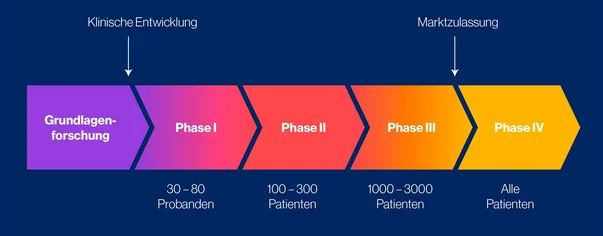
The different phases of clinical trials. Source: Novartis
Clinical trials form the foundation of medical research. They are a rigorous, multi-stage process (see graphic by Novartis) that ensures new medicines and treatments are thoroughly tested for safety and efficacy before they are brought to market.
Phase I: The investigational drug is first tested on a small group of 20 to 80 people (usually healthy volunteers) to determine how the body metabolises the drug and what the optimal dose is.
Phase II: The drug is tested on a larger group of 100 to 300 patients to gain initial insights into its efficacy and safety in patients.
Phase III: With large groups of 1,000 to 3,000 patients, the drug’s efficacy is confirmed and its safety monitored. The drug is usually compared directly with standard treatments or a placebo to determine the maximum benefit for treatment.
Phase IV: These studies take place after the drug has been authorised for marketing, with the aim of collecting additional long-term data on risks, benefits and optimal use in everyday clinical practice.
Unlike prophylactic vaccinations, such as those against coronavirus infection, this is a therapeutic application for people who are already ill. The technology also takes into account the genetic individuality of patients, resulting in a personalised vaccine.
The tumour’s genetic material is analysed and compared with healthy tissue. Using AI-supported algorithms, tumour-specific changes to the genetic material – known as mutations – are identified, and up to 34 patient-specific neoantigens are selected. These are proteins on the surface of tumour cells. Due to mutations, they differ from the proteins on the surface of healthy cells and can serve as signal flags for the immune system. The genetic information for these neoantigens is packaged into a strand of mRNA. Following injection, the mRNA forces the body’s own cells to produce these tumour neoantigens. The immune system thereby learns to recognise these ‘enemy calling cards’ and to specifically attack any remaining cancer cells.
After a median follow-up period of around 25 months, a significant therapeutic benefit was observed:
Survival without tumour recurrence: with the vaccine, 82.2 per cent of participants were alive without recurrence after two years (compared with 70 per cent in the placebo group). This corresponds to a significant risk reduction of 42 per cent. After the first six months – the time required for the immune system to build up a response – the risk of relapse fell by as much as 58 per cent.
Survival without metastases: The risk of distant metastases fell by 38 per cent. After just over two years, 88.5 per cent of patients in the group receiving the dual treatment were living without metastases, compared with 80.2 per cent in the control group.
Side effects: The profile proved to be well tolerated; side effects such as fever or injection pain were attributable to immune stimulation but did not increase long-term toxicity.
Conclusions: The study data demonstrate for the first time in a large Phase III trial that the principle of a personalised therapeutic mRNA cancer vaccine works. Although it is not yet possible to draw conclusions regarding overall survival due to the relatively short duration of the trial, the significant delay in relapses represents a major medical advance for those affected.
Approval: The manufacturers, Moderna and Merck & Co., plan to use the available data to apply for approval of the vaccine. It would be the first approval for an mRNA-based cancer vaccine.
Delayed onset of effect: In the first six months after the start of treatment, there was no significant difference between the vaccine group and the control group. As the immune system needs time to build up the T-cell response and for the vaccine to take effect, the vaccine does not initially protect against very early relapses following surgery.
Tissue procurement and logistics: Sufficient suitable tumour tissue from patients is absolutely essential for the production of the personalised vaccine. In the study, a large number of prospective participants (approximately 17 per cent) had to be excluded because the tumour samples submitted were insufficient or unsuitable for high-quality sequencing.
High effort and costs: Production is individualised, time-consuming and technically demanding. This poses a considerable economic and organisational challenge for widespread use in everyday clinical practice. According to expert estimates, the costs of such personalised therapies are expected to amount to several hundred thousand Swiss francs per patient.
The results of the clinical trial on the mRNA vaccine Intismeran are highly relevant for three reasons:
From hypothesis to evidence: For years, the idea of using mRNA to train the immune system to target specific cancer mutations was regarded as a promising immunological hypothesis. Its successful implementation as part of a global Phase III trial transforms this concept into clinical evidence. The approach could potentially be adapted for other types of tumour.
A breakthrough in personalisation: This success marks a paradigm shift towards molecularly tailored medicine. Patients thus receive a drug individually tailored to their tumour biology, which maximises the efficiency of treatment and minimises the blind spots of conventional therapies.
A new era for oncology: Young companies such as the Basel-based start-up Abbmira Therapeutics are pursuing similar, groundbreaking combination approaches (Abbmira showcase). Whilst mRNA vaccines train the immune system via neoantigens, Abbmira uses computer-aided screening and AI to identify bacterial cell wall components that break down the immunosuppressive tumour microenvironment and pave the way for combination with established immunostimulators. Oncology is entering a new era in which computer science, biotechnology and clinical research work hand in hand.
| Role | Title + Name |
|---|---|
| Text by | Claudia Schärer |