Translated by an automated translation plugin.
Agent-based AI goes beyond traditional assistance systems: it is designed not only to provide information, but also to plan, coordinate and carry out tasks within defined parameters.
Early industrial applications are already demonstrating tangible benefits: for example, the company Change3D has been able to automate parts of its administrative order processing and significantly reduce the workload.
The future of industry lies not in autonomous AI systems alone, but in the interaction between humans, AI agents and intelligent physical systems such as robots. Objectives, oversight and responsibility remain with humans.
The use of agent-based AI raises societal questions: issues such as value creation, skills, employment and the distribution of productivity gains must be actively addressed.
For Switzerland as an industrial hub, various future paths lie ahead: ranging from a loss of industrial competitiveness and technological dependence to a self-reliant Industry 5.0 that builds up and helps shape its own expertise in AI and robotics.
The SATW Digital Industry Specialist Group is launching a new format: in future, each meeting will focus on a specific theme, the key findings of which will be summarised in a news article. The aim is to raise the profile of discussions within the specialist group and to keep Swiss industry and the advanced manufacturing community informed about relevant technological developments. To kick things off, the specialist group is focusing on a topic that goes far beyond traditional automation: agent-based AI and its potential role in the industry of tomorrow.
Change3D, a Swiss provider of additive manufacturing (3D printing), has been able to automate part of its administrative order processing with the help of artificial intelligence. This saves the company a great deal of time. According to Kevin Seliner, Chief Sales Officer at Change3D, the annual time saved amounts to the equivalent of around 1,200 working hours.
This example shows that the benefits of AI do not necessarily have to result in a fully autonomous factory. Even in order processing, it can help to significantly reduce the amount of manual work required. At the same time, the question arises as to what becomes possible when AI not only supports isolated tasks but takes over interconnected processes.
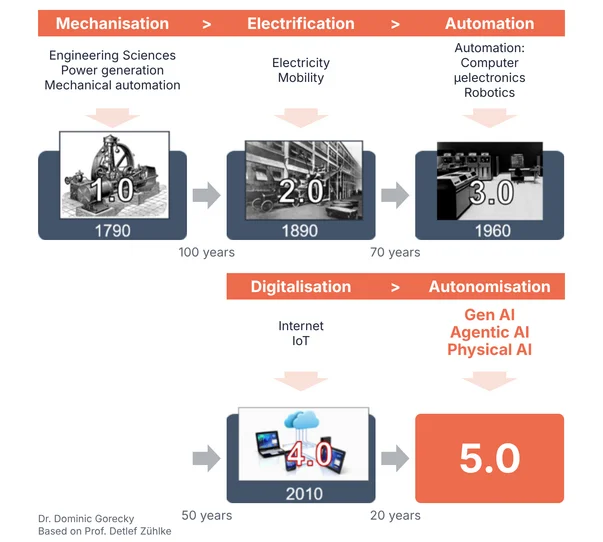
Dr Dominic Gorecky, Head of the Swiss Smart Factory (SSF) at the Switzerland Innovation Park Biel/Bienne and co-founder of the Swiss Cobotics Competence Centre (S3C), ventured this forward-looking perspective in his keynote presentation ‘Industry 5.0: Vision & Future Outlook’. In his model, Industry 4.0 – with its networked machines, end-to-end data and integrated processes – forms the foundation. Industry 5.0 builds on this foundation and expands it to include a consistently human-centred perspective, as well as technologies such as generative AI, AI agents and physical AI. The next step in development thus leads from pure digitalisation towards the autonomisation of processes and systems.
Individual, automated tasks are transformed into interconnected workflows and entire work packages. The ‘One prompt, onework package’ vision describes systems that plan, execute, review and improve work within a specified framework. For example, in future a single prompt could trigger the development of a new product – from the analysis of requirements through to concept and design, right through to simulation, documentation and preparation for production. Similar approaches are conceivable for complete customer orders, production planning or the optimisation of a production line.
This represents a direction of development rather than a promise of unrestricted autonomy. Objectives, oversight and final decisions remain with humans.
From digitalisation to autonomy: Industry 5.0 builds on the foundations of Industry 4.0 and complements them with human-centred approaches and technologies such as generative AI, AI agents and physical AI. Image: Dominic Gorecky, Swiss Smart Factory (SSF).
The focus here is not on a single technology, but on the interplay between three roles: the digitally supported human, the AI agent and physical AI.
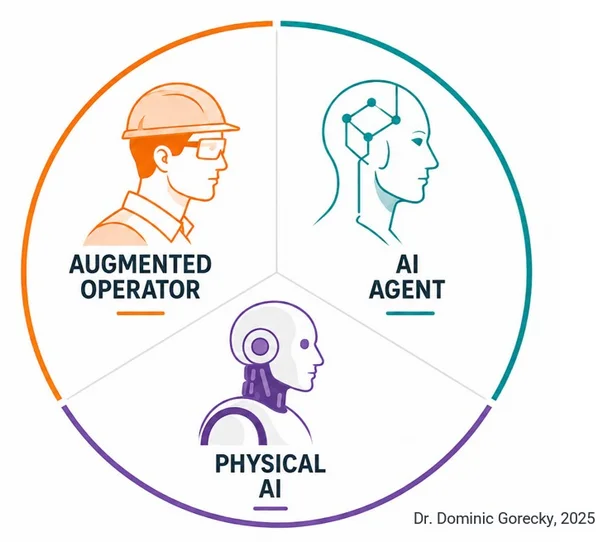
At the heart of Industry 5.0 lies the interaction between humans, AI agents and physical AI. It is not the individual technology that is crucial, but the effective collaboration between these roles throughout the value chain. Image: Dominic Gorecky, Swiss Smart Factory (SSF).
The augmented operator brings experience, specialist knowledge and sound judgement to the role. Digital assistance and AI are designed to support them in utilising information, making decisions and carrying out tasks.
The AI agent handles digital tasks and coordinates work processes. Unlike a purely conversational system, it is not merely intended to formulate responses, but to contribute to the execution of work within defined parameters and in collaboration with humans and other AI agents.
Physical AI connects these capabilities of AI agents with the real world. In doing so, autonomous systems comprising sensors and robots take on physical tasks within the workplace and protect or relieve humans of some of their workload.
The crucial question is therefore not what an AI system can achieve on its own, but how humans, digital agents and physical systems can form a reliable team.
This perspective opens up potential for more productive, adaptable and people-centred processes. Successful implementation requires a holistic strategy. The ‘Industry 5.0 Team’ needs a robust data and technology foundation, clear responsibilities and appropriate expertise to consciously address the resulting risks.
The discussion within the SATW Digital Industry Expert Group went beyond operational efficiency. For if the value creation previously performed by humans is increasingly carried out by digital and physical AI, this affects society as a whole. It is no longer simply a matter of completing existing work more quickly, but also of how tasks, roles and the distribution of value creation are changing.
This raises fundamental questions: Who benefits from productivity gains? How do people remain involved in value creation? What skills will be needed in future, and how can employees successfully navigate the transition? A people-centred Industry 5.0 does not emerge automatically through the use of new technology. It must be consciously shaped.
To illustrate the consequences arising from the ‘Industry 5.0 Team’, Dominic Gorecky formulated three extreme visions of the future for Switzerland as an industrial hub: Switzerland falls behind, becomes dependent, or plays a leading role. These scenarios are intended as food for thought to spark discussion on a sustainable approach to AI.
The Alpine Museum. Industrial production in Switzerland is becoming increasingly uncompetitive and is gradually disappearing from the country. What remains are primarily services, agriculture and tourism. The image of disused factories symbolises a country that has waited too long and, as a result, is losing a key part of its industrial value creation.
The AI colony. Industry utilises AI but sources the crucial technologies from abroad and fails to build up its own capabilities sufficiently. In this scenario, modernisation does take place, but key technological decisions and parts of the value chain lie outside Switzerland. The country is a user but does not help shape developments.
The sovereign industry. Switzerland shapes an independent Industry 5.0 and links its industrial base with its own expertise in AI and robotics. In this vision of the future, people, AI agents and physical systems work together; sustainability, resilience and a people-centred approach become integral to industrial renewal. Sovereignty does not necessarily mean manufacturing every component in-house. What is crucial is understanding key technologies, helping to shape them and deploying them in a self-determined manner.
A key conviction emerged from the discussions. Switzerland has the potential to keep pace with this development. The crucial factor is whether the will to digitalise is also translated into concrete action. This involves further developing digital foundations, testing suitable applications, building up expertise and involving staff.
The choice between an Alpine museum, an AI colony and an independent Industry 5.0 is not determined by technology alone. It is also about the willingness to take responsibility for our own industrial future. The question ‘Quo vadis, Switzerland?’ is therefore, above all, an invitation to help shape the future.
| Role | Title + Name |
|---|---|
| Text by | Dominic Gorecky |
| Expertise | Manuel Kugler, Guido Piai, Daniel Schmid |