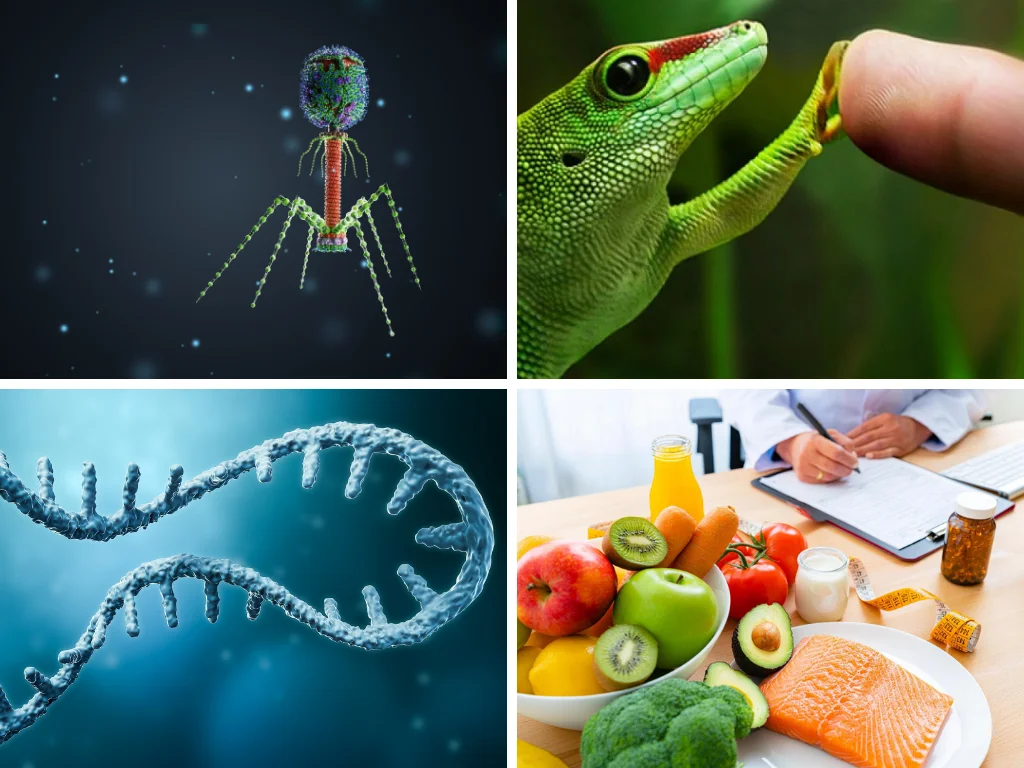
The diversity of modern life sciences technologies is impressive. While some are based on natural principles that are thousands of years old, others utilise the latest genetic findings. What they all have in common: They all promise more sustainable, more precise and more effective solutions to the challenges of our time. This article highlights four technologies from the Technology Outlook that could hardly be more different - and yet together they will shape the future of medicine, nutrition and sustainability.
Every year, more than one million people worldwide die from bacterial infections against which conventional antibiotics are no longer effective. At the same time, the food industry and agriculture are looking for alternatives for germ control, and an old technology is making a comeback: bacteriophages are viruses that exclusively use bacteria as host cells and kill them in a targeted manner.
Phages work like a precision tool: in most cases, a phage species only attacks a specific type of bacteria, leaving useful bacteria untouched. In medicine, they may currently only be used in life-threatening situations in Switzerland. Successful individual treatments for urinary tract infections or joint prostheses show the potential. Belgium is playing a pioneering role thanks to its flexible regulations.
Phages are already being used preventively in the food industry to eliminate pathogenic bacteria such as listeria or salmonella. While countries such as Canada and the USA have already developed commercial products for this purpose, phages are only authorised as an exception in cheese production in Switzerland. In agriculture, phage cocktails, i.e. a mix of different phages, could replace antibiotics and chemical pesticides. In Switzerland, however, this use is not permitted for outdoor crops.
Swiss research groups at ETH Zurich, ZHAW and university hospitals such as Balgrist are doing pioneering work in basic research. However, commercialisation is lagging behind and offers opportunities for start-ups. The biggest challenge remains the lack of proof of medical efficacy through international clinical studies. There is also a lack of clear framework conditions and authorisation procedures in Switzerland, and it could be worth taking a leaf out of Belgium's book in order to realise the full potential of this technology.
Over thousands of years, nature has developed solutions that have been copied and further developed by science and industry. Bioinspiration utilises natural models and abstracts their functions for technical applications. Examples range from winglets on aeroplanes, which are modelled on eagle wings, to water-repellent surfaces that function like lotus leaves.
Swiss spin-offs are bringing innovative solutions to the market: Morphotonix, an EPFL spin-off, for example, uses nanolithography to counterfeit banknotes, passports and watches, engraving tiny structural changes directly into the products as uncopyable security features. This technology was inspired by the tropical morpho butterflies, whose wings shimmer in different shades of blue depending on the incidence of light.
The start-up Seprify, on the other hand, is developing natural, cellulose-based white pigments for toothpaste and cosmetics to replace potentially environmentally harmful titanium dioxide, while the Adolphe Merkle Institute is also developing self-healing materials with antibacterial properties for wound care.
And what about research? The NCCR Bio-Inspired Materials at the University of Fribourg and the ETH programme ALIVE (Advanced Engineering with Living Materials) are well positioned to drive these developments forward. The biggest challenge remains scaling up from the laboratory to market maturity and the stability of the materials over long periods of time.
The coronavirus pandemic has made mRNA technology world-famous. But its potential extends far beyond Covid vaccines. This technology can also be used to produce therapeutic proteins specifically in human cells. The mRNA can both replace faulty proteins and produce new proteins that do not occur naturally in the body.
In addition to vaccines against the coronavirus, vaccines against influenza viruses and RSV (respiratory syncytial virus) are currently being authorised. In cancer therapy, the first mRNA-based vaccines are being tested to enable the immune system to specifically recognise and destroy tumour cells.
Switzerland experienced a turning point: Before the pandemic, little was invested in mRNA research. Between 2021 and 2024, however, the Swiss National Science Foundation funded the National Research Programme "Covid-19" (NRP 78). In 2020, Lonza set up production facilities for mRNA vaccines in Visp in cooperation with Moderna. Novartis opened a production facility for mRNA therapeutics in Schweizerhalle in 2023. Swiss companies such as Haya Therapeutics and TargImmune Therapeutics are working on innovative applications, although Switzerland is lagging behind the USA and Germany when it comes to commercialisation.
The advantages are considerable: small batches only take two to three weeks and laboratory quantities only hours, enabling rapid adaptations to new virus variants and personalised therapies for rare diseases. However, the greatest challenge remains the targeted application in specific tissues. Intravenously administered mRNA mainly reaches the liver.
What if nutritional recommendations were tailored to an individual's genetic profile, metabolism and lifestyle? Personalised nutrition involves analysing genetic material, microbiome, metabolism and physical activity in order to prevent lifestyle diseases and nutrient deficiencies.
Three business models dominate the market: firstly, test kits and wearables. Test kits measure nutrition-specific biomarkers such as vitamins, amino acids or trace elements in blood, saliva or urine samples, while DNA tests analyse relevant genes. A common example is the prediction of vitamin B12 requirements. Wearables enable continuous real-time monitoring of blood glucose levels as an indicator of health progression due to diet and lifestyle. Secondly, there are apps and counselling: users regularly enter their health and nutrition-related data and receive forecasts and recommendations for a healthy lifestyle. Thirdly, there are specific products such as nutritional supplements that are tailored to individual needs.
In Switzerland, SMEs in particular are driving development forward. Great progress has been made with less invasive analyses such as saliva, urine or breath samples. The Swiss Food & Nutrition Valley initiative connects over 80 companies, research groups and authorities on its platform.
The challenge at present is that personalised products are expensive and in many cases there is still a lack of scientific evidence that the higher costs pay off in better health. The future will be characterised by AI solutions that integrate laboratory analyses, health data and lifestyle factors. This could increase quality and reduce costs.
These four technologies could hardly be more different - and yet together they demonstrate the strengths and challenges of Switzerland as a life sciences location. Bacteriophages reuse ancient natural principles, bioinspiration copies nature to find sustainable solutions, mRNA enables the flexible production of therapeutics and personalised nutrition adapts to the individual.
What they have in common: Swiss research is doing pioneering work in all four areas, with ETH Zurich, EPFL, the universities and universities of applied sciences as well as research institutes such as Empa and Agroscope providing excellent basic research. National research priorities such as the NCCR Bio-Inspired Materials or NRP 78 on Covid-19 pool expertise and facilitate international collaboration.
Switzerland is also strong when it comes to translation into innovative products: spin-offs such as Xemperia, Morphotonix and Seprify, established companies such as Lonza and Novartis and numerous SMEs bring innovations to the market. Initiatives such as the Swiss Food & Nutrition Valley network players and promote the transfer of knowledge.
However, there is also a need for action in all four areas: there is a lack of a clear regulatory framework for bacteriophages. In the case of bioinspiration, scaling up from the laboratory to market maturity is a challenge. In the case of mRNA, Switzerland is lagging behind other nations in terms of commercialisation. And in the case of personalised nutrition, there is often still a lack of scientific proof of the benefits.
The message is clear: Switzerland has the potential to play a leading role in all of these areas. However, this requires increased networking between science and industry, a clear regulatory framework and the courage to commercialise. The diversity of approaches is a strength here - because the challenges of the future require multiple solutions.
| Role | Title + Name |
|---|---|
| Text by | Esther Lombardini |