Dr Adrian Tica
ETH Zürich
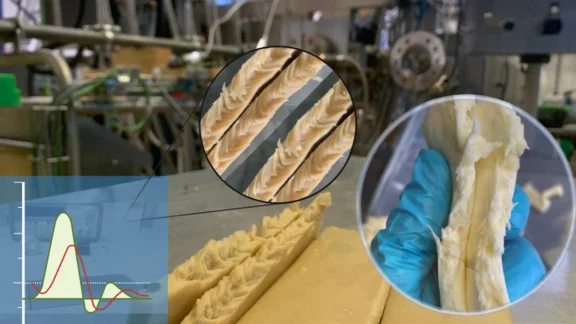
Extrusion, particularly high moisture extrusion (HME), is an appealing technology for food manufacturers, offering a versatile approach to creating alternatives to meat, dairy or hybrid products. This project is investigating and developing a non-invasive (non-contact) ultrasound-based sensing system for in-line product properties measurement. Focusing on reducing empiricism, the primary goal is to ensure real-time, reliable measurements to facilitate integration into closed-loop strategies for automatic control of HME.
Translated by an automated translation plugin.
In the project, an ultrasonic measuring system was successfully integrated into a pilot- / lab-scale extrusion line to monitor the texture characteristics of plant-based meat alternatives in real time. The system recognised various recipe and process changes, confirming the technology's potential for process monitoring and control in extrusion. At the same time, however, it became clear that further optimisation is required to increase reproducibility, robustness against fluctuations, and overall reliability — an area on which ongoing research is focused.
Within this project, a non-invasive sensing system based on Ultrasound (US) attenuation technique was adapted and successfully installed at the exit of the cooling die of a pilot- / labscale extruder for in-line measurement of product texture characteristics. The feasibility of the US-attenuation technology was investigated in the context of the high moisture extrusion (HME) for producing plant-based (soy- and pea-protein) meat alternatives. Systematic US-attenuation measurements were taken during multiple extrusion runs, with variations in recipe (e.g., feeding rate, powder/water content) and processing parameters (e.g., heating/cooling temperature, screw speed).
The US measuring system detected changes in the transmitted signal amplitude / attenuation, which could be correlated with variations in recipe and processing parameters. In particular, the US-attenuation technique demonstrated sensitivity by capturing changes as small as 1% in moisture and powder (i.e., Soy Protein Concentrate or Pea Protein Isolate) content, as well as variations in heating or cooling temperature within a range of 5°C. These results underline the system's capability and potential for monitoring and control in extrusion processes. It represents a key step in detecting and tracking variations that directly impact product properties and quality. Nevertheless, achieving higher consistency, robustness to variability in operating conditions and ingredient composition, replicability, and overall reliability requires further refinement, which is being addressed through ongoing research.
In addition, models relating (a) process variables and (b) US-attenuation characteristics to (c) product mechanical properties were successfully derived. Notably, the development of models (i.e., soft sensors) was carried out using standard machine learning algorithms, with mechanical properties, measured in the laboratory using a Texture Analyzer, provided as output variables. Various machine learning methods, including (i) Linear Regression, (ii) Random Forest, and (iii) eXtreme Gradient Boosting, were tested and compared to predict the mechanical attributes: (1) hardness, (2) chewiness, and (3) gumminess. The generalizability and performance of the trained models were evaluated using cross-validation, which showed consistent results, achieving relative errors below 3%. The models fit the test data accurately, capturing the variance in the output variables, with a coefficient of determination (R² score) exceeding 97%.
The framework for measuring the damping of ultrasonic waves during HME processing and the data pipeline for integration as features in the modeling approach has been successfully established. This provides a solid basis for creating an effective sensing system for in-line characterization of structured protein-rich foods, enabling more reliable and generalized representations as larger datasets can be collected and become available. Moving forward, expanding the data repository and enhancing the models’ robustness, along with improving the US-measuring system to more broadly capture attenuation/propagation wave patterns specific to the internal structure and composition of product, are expected to be key objectives for upcoming projects.
The developed models can be integrated into a feedback structure for predictive quality control atop the HME control system. Within a hierarchical approach, they can automatically determine reference values or constraints for a model-based predictive controller by linking input variables to quality attributes: (1) hardness, (2) chewiness, and (3) gumminess, enabling optimized, data-driven production processes.
In the Food 4.0 programme, the Swiss Academies of Arts and Sciences, under the leadership of the Swiss Academy of Engineering Sciences SATW, support innovative project ideas that are at the very beginning of development. In particular, the programme supports projects that demonstrate new perspectives for the successful development of the Swiss food system. The selected projects make an important contribution to solving the greatest challenges and address the topics of food waste, sustainability and health.
