Prof. Tiffany Abitbol
EPFL
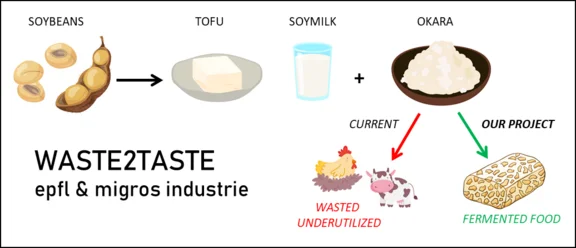
In the light of its protein value in particular, the substantial amounts of wasted or underutilised okara have prompted new efforts to repurpose it into food products. In this project, we plan to ferment okara with edible fungi to create a nutritious food, whose composition, flavour, and texture are shaped and potentially transformed by the growth of a living organism – the fungi.
Okara, a nutrient-rich by-product of soy processing, was successfully fermented with two types of fungi to produce firm, tempeh-like products. Under optimal conditions, a protein-rich, textured product with similar properties to conventional soy-based tempeh was produced. The project thus demonstrates the potential for transforming fresh okara into a nutritious, protein-rich food.
Okara, a by-product of the soymilk and tofu-making industry, is often underutilized and discarded despite its high nutritional value. This study explored the use of two fungal species, Rhizopus oligosporus and Pleurotus ostreatus, to optimize fermentation parameters for producing cohesive, sliceable cakes within a reasonable time frame (24-72 hours). The ideal fermentation conditions were determined to be 70% water content in the starting okara cake, inoculation with R. oligosporus at 15 g/kg, a temperature of 30°C, and a fermentation time of 48 hours in the dark. The resulting products were benchmarked against a commercial tempeh made from soybean fermentation with R. oligosporus, showing similar mechanical properties and nutritional values. Compared to the starting okara, the 48-hour R. oligosporus-fermented cake had a similar protein content of approximately 30%, while its fat and dietary fiber contents were each reduced by ~9%, and its carbohydrate content increased by ~14%. These changes are characteristic of the dynamic compositional shifts that occur during fermentation. After 72 hours of fermentation, the gross nutritional contents, as evaluated by Big 8 analyses, showed a close similarity between the starting okara and the fermented cake.
The compressive moduli of all fermented cakes produced in this study ranged from approximately 0.5 to 0.2 MPa, with the optimized condition yielding a cake with a compressive modulus very similar to that of commercial tempeh, at around 0.12 MPa. These findings provide a foundation for further research and potential commercial application of okara-based tempeh.
Future research should focus on identifying conditions that allow for the direct fermentation of as-produced okara (> 80% water content) without requiring drying, taking advantage of the inherent sterility in commercial soymilk and tofu-making processes. Additionally, further exploration is needed to understand how the taste and nutrition of the cakes change with different fungal species and fermentation times. It is also recommended to introduce structure to the okara, either before or after fermentation, to improve the texture and avoid the mealy, grainy consistency observed in the current cakes. Finally, this research demonstrates the feasibility of transforming okara into a nutritious, protein-rich food product, contributing to sustainable food production and waste reduction goals.
In the Food 4.0 programme, the Swiss Academies of Arts and Sciences, under the leadership of the Swiss Academy of Engineering Sciences SATW, support innovative project ideas that are at the very beginning of development. In particular, the programme supports projects that demonstrate new perspectives for the successful development of the Swiss food system. The selected projects make an important contribution to solving the greatest challenges and address the topics of food waste, sustainability and health.
