Dr Johannes Burkard
CHoNova AG
By using advanced technologies such as DetachLog, which uses ultrasound spectroscopy for inline and offline monitoring of chocolate structure formation and raw material characterisation, chocolate manufacturers can optimise their processes, reduce waste and ensure consistent quality in times of price pressure caused by high energy and raw material costs. In particular, the inspection of filled products which consist of a casing and a filling compound with different physical properties is very complex. Their monitoring and control is the main focus of the CHoNova research project as part of SATW Food 4.0.
Translated by an automated translation plugin.
The project investigated the structural development of filled chocolates during the cooling process. Using ultrasonic amplitude attenuation spectroscopy and temperature measurements, the crystallization and solidification of the shell and filling were monitored in real time. The results lay the groundwork for data-driven process optimization and more resource-efficient manufacturing with fewer production defects.
Filled chocolate products are among the most technologically challenging items in the confectionery industry. Their production requires precise control of two physically distinct masses—for the shell and the filling—whose crystallization behavior, heat release, and volume contraction can differ significantly from one another. Even minor deviations from the optimal cooling process lead to defects such as cracking, filling displacement, or filling leakage. Since defective products cannot be reworked, this results in immediate economic losses.
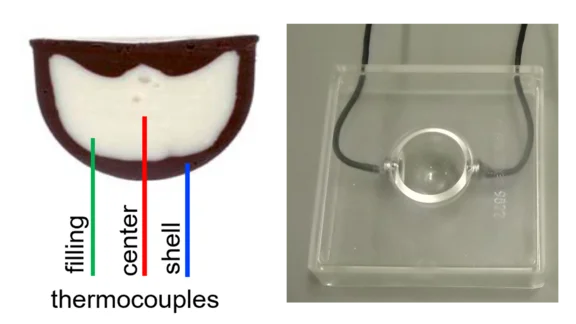
The goal of the project was to develop a metrologically sound, data-driven understanding of the structural development of filled chocolates under industrial-scale cooling conditions. The core method used was ultrasonic amplitude attenuation spectroscopy (USAD), which captures the transition of the cocoa butter fat phase from a viscous molten state to an elastic fat crystal network in real time. In addition, local temperature sensors were placed at various product layer levels within the mold, allowing the heat transfer processes in the shell and filling to be tracked simultaneously and with spatial resolution.
In an initial step, dark and white chocolate coatings were characterized rheologically and using ultrasonic spectroscopy on a laboratory scale. The greater viscous damping of the dark chocolate coating was attributable to its higher solids content; the white chocolate coating, on the other hand, crystallized more quickly and efficiently due to its higher fat content. In addition to the onset of crystallization, the shell thickness at the time of release from the mold proved to be a decisive influencing parameter for deformation resulting from concomitant volume contraction.
The USAD measurements enabled, for the first time, a clear metrological differentiation between shell release on the one hand and the formation of structure in the shell and filling on the other. Under defined cooling conditions (11 °C cooling air temperature, approx. 1 m/s air velocity), thin shells showed extensive solidification after just 300–500 s and complete release from the mold after 500–700 s. This suggests that filling could be initiated earlier than has been customary—with corresponding potential for energy and time savings in the shell cooler.
After dosing the molten filling material into the detached shell, a pronounced increase in ultrasonic attenuation was initially detected due to viscous energy dissipation of the filling material, followed by an increase in amplitude as the material took on more solid-like characteristics. The attainment of a plateau in the ultrasonic signal reliably indicated that the filling solidification was complete, and the cooling process could be terminated. Furthermore, it was demonstrated that dispensing the filling material into a shell that had completely detached from the mold is possible without significant risk of the mold melting.
The USAD characteristics determined in the laboratory were confirmed in industrial in-line measurements. In addition, an influence of mechanical vibration during shell forming on the mold release behavior was demonstrated—a finding that opens up new control variables for process optimization. Furthermore, a Temper Index (TI) determination under authentic conditions (laboratory mold, industry-like cooling air parameters) yielded more reliable parameters than conventional TI measurement methods and improved the transferability of laboratory data to an industrial scale.
The results obtained lay the foundation for AI-supported data pattern recognition and model-based process optimization, as planned for the future. Linking USAD measurement data with thermomechanical process simulations, as well as characterizing the rheology and pre-crystallization intensity of the melts to be cast, will enable more precise predictions of solidification and mold release behavior in the future. This forms the technological foundation for resource-efficient, defect-minimized production of filled chocolates in line with Food 4.0.
Through the Food 4.0 program, the Swiss Academies of Sciences, led by the Swiss Academy of Engineering Sciences (SATW), support innovative project ideas that are in the very early stages of development. Funding is provided in particular for projects that open up new perspectives for the successful development of the Swiss food system. The selected projects make an important contribution to solving the greatest challenges and address the issues of food waste, sustainability, and health.
