Fanny Louviot
BFH-HAFL
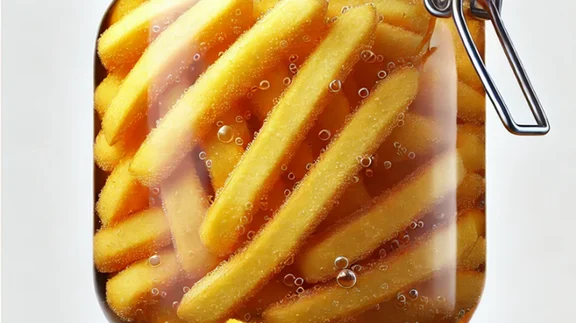
The project explores a novel approach to French fry production by integrating lactofermentation—an established preservation technique—into the process. This method could potentially reduce the need for energy-intensive steps like blanching and freezing, offering the possibility to improve the energy efficiency of production and storage while maintaining the quality and taste of the fries.
The project developed a reproducible fermentation process for French fries by optimising the availability of naturally fermentable carbohydrates in potatoes. The resulting process produced microbiologically safe fries with encouraging consumer acceptance. The findings identified texture, acidity and storage stability as key areas for further development and established a basis for follow-up work exploring more resource- and energy-efficient production and preservation concepts.
The project aimed to develop a robust, reproducible fermentation protocol for French fries and to investigate storage strategies to ensure microbiological and sensory stability. Initial experimental trials showed that fermentation performance strongly depends on the availability of fermentable substrates in the potato matrix. The initial protocol, which involved fermenting the fries in a brine under standard conditions, did not result in functional fermentation, as the brine pH remained above 5 after five days. Testing a range of conditions—including higher inoculum concentrations, anaerobic versus aerobic fermentation, and omitting the washing step—revealed that insufficient fermentable sugars were the main limiting factor. Supplementary trials confirmed that increasing sugar availability is crucial for lactic acid bacteria activity. To avoid external sugar addition, a targeted conditioning step of the raw material was integrated prior to fermentation, increasing the availability of naturally fermentable carbohydrates and enabling a functional and reproducible fermentation process.
Based on internal tastings, the blanching step was reintroduced, as it proved necessary to achieve a tender internal texture. However, blanching increased brine absorption, raising perceived saltiness; the process was therefore adjusted to balance fermentation performance with sensory quality. Microbiological analyses confirmed product safety, with levels of Enterobacteriaceae, Escherichia coli, Bacillus cereus, yeasts, and molds below recommended thresholds.
Consumer testing with 67 participants indicated that crust color, internal texture, and saltiness were generally rated “just right”, though crispiness was identified as a key attribute for further optimization. Acidity was also identified as an area for improvement; while 42% rated it “just right”, 48% found the fries slightly too acidic. These results highlighted the importance of fine-tuning fermentation parameters to further optimize sensory quality. Overall, 53% of participants stated they would order the product again, demonstrating strong market potential for fermented fries.
The project also explored brine valorization. Preliminary characterization suggested potential applications, including reuse as a fermentation medium, as a food ingredient (e.g., sauces or marinades), or for exploratory fractionation to extract bioactive components. Storage studies showed that extended preservation under the tested conditions led to over-acidification, while short-term storage under vacuum, pasteurization, and refrigeration maintained fry quality for up to one week. Further work is currently addressing texture optimization, fermentation kinetics and the development of more sustainable storage strategies.
In conclusion, this project successfully developed a functional, microbiologically safe fermentation protocol for French fries and demonstrated encouraging consumer interest. While selected aspects such as texture, acidity and storage duration require further development, fermentation shows significant promise as a more sustainable alternative to conventional French fry production.
In the Food 4.0 programme, the Swiss Academies of Arts and Sciences, under the leadership of the Swiss Academy of Engineering Sciences SATW, support innovative project ideas that are at the very beginning of development. In particular, the programme supports projects that demonstrate new perspectives for the successful development of the Swiss food system. The selected projects make an important contribution to solving the greatest challenges and address the topics of food waste, sustainability and health.
