Translated by an automated translation plugin.
A sustainable alternative to a controversial pigment: The Freiburg-based start-up Seprify produces a biocompatible, cellulose-based whitening agent – as an alternative to titanium dioxide (TiO2), which the EFSA classified as potentially mutagenic in 2021 and which has been banned in food since 2022. The TiO₂ market amounts to up to 10 million tonnes per year, with a turnover of around 16 billion US dollars.
Bioinspiration as the starting point: The idea stems from the Southeast Asian beetle Cyphochilus, whose chitinous shell appears dazzlingly white thanks to its fine molecular structure. In Cambridge, Lukas Schertel and his team succeeded in transforming cellulose into particles with the same optical properties.
Funding schemes paved the way: A Bridge grant from the SNF and Innosuisse, as well as several Innosuisse projects, enabled the transfer of knowledge from basic research to a marketable product – including patents, feasibility studies and a fully automated pilot plant at the Marly Innovation Centre.
Scaling up as the litmus test: production capacity grew from laboratory scale to one metric tonne per year. The process takes place under highly controlled and mild conditions – with 80 per cent fewer CO₂ emissions than in titanium dioxide production.
A culture of innovation is a culture of dialogue: at Seprify, regular meetings foster dialogue between sales, engineering and research. This ensures that customer needs are directly incorporated into product development.
On the cusp of moving beyond the start-up stage: In March, Seprify secured Series A funding of over 12 million Swiss francs. This will enable production to be scaled up to hundreds of tonnes per year – in partnership with experienced manufacturers.
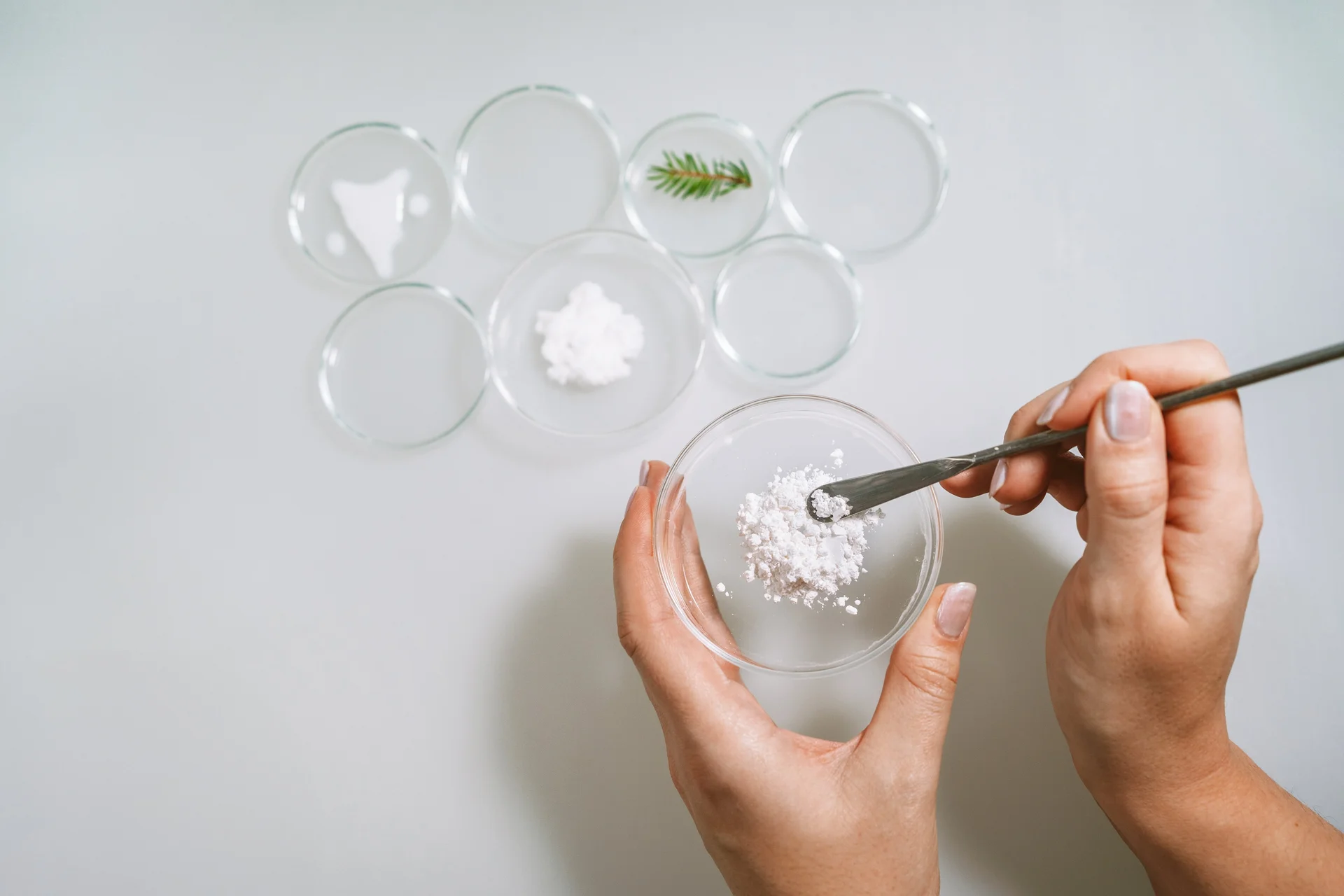
At the headquarters of the Swiss start-up Seprify in Marly (FR), CEO and co-founder Lukas Schertel takes a small bowl containing a dazzling white powder from the display cabinet. The company owes its success to this powder. It is a biocompatible whitening agent based on cellulose and a substitute for the widely used but controversial white pigment titanium dioxide (TiO₂). Today, just four years after its foundation, the company is on the verge of entering the market.
The market for titanium dioxide is huge. Up to 10 million tonnes are produced worldwide each year, with a turnover of around 16 billion US dollars. However, the metal oxide is increasingly under scrutiny due to health concerns. In 2021, the European Food Safety Authority (EFSA) classifiedTiO₂ as potentially mutagenic; since 2022, it has been banned in foodstuffs, including in Switzerland. Yet it is still used in many products: in toothpastes, sun creams, plastics, as well as in wall paints and coatings, for example on furniture. The production of titanium dioxide is also energy-intensive, generates highCO₂ emissions and, at the end of the products’ life cycle, the ingredient also has an environmental impact. The industry is therefore seeking sustainable alternatives that also fit into an environmentally sound circular economy.
Throughout his research career, Lukas Schertel has long been engaged precisely with the expertise required for such an innovation. As a physics student in Zurich, he had studied the properties of optical materials. He then completed a postdoctoral fellowship at the University of Cambridge in Prof. Silvia Vignolini’s group, where he researched cellulose and its optical properties. Cellulose is a component of all plant cells and is found in abundance, particularly in the wood of trees.
During his research in South-East Asia, Lukas Schertel came across a bizarre beetle called Cyphochilus with a dazzling white chitinous shell. ‘The secret lies in the fine molecular structure of the biopolymer chitin, which scatters light so widely that the shell appears so white,’ explains Schertel. This realisation piqued his curiosity: surely it must be possible to break down the biopolymer cellulose – which naturally forms long fibrils – into molecules with similar optical properties? Back in Cambridge, the researchers undertook painstaking laboratory work to test all the physical and chemical process steps required to transform the raw material into clearly defined particles with the desired optical properties – and they succeeded.
“That was the moment I decided to become an entrepreneur,” recalls Lukas Schertel. From then on, he was preoccupied with new questions: What are we going to do with our idea? What technologies can we use to scale up the process? Is there a market? Schertel discussed the matter within the research group, delved into the specialist literature and held numerous discussions with industry representatives who were already desperately seeking alternatives to titanium dioxide. “I was in the right place at the right time,” says Lukas Schertel, looking back. “Although there was no ban on titanium dioxide in food at the time, it was already a contentious issue. The trend towards sustainable production and the circular economy also gave us a boost.”
When he returned to Switzerland after his postdoctoral research, he had already worked out the pitch for his business plan in his mind. “I soon realised that we could provide a solution to the problem,” explains Lukas Schertel. He moved to Fribourg, where he found a thriving ecosystem centred on bioinspiration, thanks to the university and the Adolphe Merkle Institute. He then received a Bridge grant. This funding scheme, jointly financed by the Swiss National Science Foundation and Innosuisse, has been awarded since 2017 and is designed to promote the transfer of knowledge from basic research into innovative products. Schertel used the support to drive forward his roadmap from the initial idea to a market-ready product. This involved hard graft in the laboratory, feasibility studies, patent applications, licensing agreements, market analyses and, of course, repeated discussions with potential customers.
In autumn 2022, the time had finally come. Together with his business partner Oliver Polcher and Silvia Vignolini, he founded the start-up Seprify (then known as Impossible Materials). He also brought Wadood Hamad onto the team as head of technology, who brought with him many years’ experience in the cellulose industry.
Then things moved in quick succession: the start-up won the Bill de Vigier Foundation’s start-up prize, secured several Innosuisse projects and moved from the research laboratory to the Marly Innovation Centre. In the premises where Ilford had produced films and photographic paper until 2013, Seprify set up a fully automated pilot plant using commercially available cellulose processing equipment, thanks to support from Innosuisse. In one fell swoop, production capacity was scaled up from laboratory scale to one metric tonne per year.
Scaling up production processes is the litmus test for any technology on the path to innovation. “This step makes the difference between a good idea and a real product that is successful on the market,” says Lukas Schertel. This is where it becomes clear whether the process works just as well on a large scale as it does in the laboratory. The scaling up of the laboratory trials was successful: every step in the process is carried out under highly controlled conditions. The entire process also consumes little energy, as it takes place under mild conditions. And compared with the production of titanium dioxide,CO₂ emissions are 80 per cent lower. Above all, the process also yielded a high-quality product at an industrial scale whilst maintaining a high yield – the fundamental prerequisite for cost-effective production and, ultimately, a competitive product.
The way was now clear for commercial scaling. This includes a market strategy focused on innovation – in other words, new products. This is because Seprify’s technology enables the production of cellulose particles with different properties for various applications. “The white pigment designed to replace titanium dioxide was our first product,” says Lukas Schertel. “Today, we can also incorporate additional functions into our cellulose molecules, such as UV protection, or produce matt surface properties for coatings.”
A culture of innovation also plays a central role for a start-up. Whilst the technical know-how is protected by numerous patents, as soon as a product establishes itself on the market, competition or changing conditions can erode the technological lead. It is also important to spread the entrepreneurial risk.
A culture of innovation can only flourish where it is actively practised by people in their day-to-day work. Seprify currently employs 21 staff. A third are research staff who develop new products in the research department. A third work in engineering. And staff in the sales department, who maintain contact with customers, are becoming increasingly important.
According to Lukas Schertel, a vibrant culture of innovation is reflected above all in a company’s culture of dialogue. “Many problems in growing companies arise because staff no longer talk to one another,” says Lukas Schertel. “The key to success is communication, including between the various departments.” He has therefore introduced regular meetings at the start and end of the week to specifically encourage dialogue between the sales team and the technical and research departments. Staff in direct contact with customers bring forward the customers’ needs, whilst the researchers demonstrate what is technically possible.
On 10 March this year, Seprify celebrated another milestone. On that day, the company secured Series A funding totalling over 12 million Swiss francs. This will enable it to scale up production of its products to hundreds of tonnes per year – not in its own factory, but through a partnership with experienced manufacturers. “This is a major step forward for the commercialisation of our products, as we can now supply them reliably to our customers,” says Lukas Schertel. It is quite possible that Seprify will soon move beyond the start-up stage.
| Role | Title + Name |
|---|---|
| Text by | Matthias Meili |